
On this page
The best Brandwatch alternative in 2026 is buzzabout, because it removes the thing Brandwatch meters: the question. Instead of Boolean queries rationed by contract, you ask in plain language and pay a flat self-serve price.
Brandwatch was built for a different era of this category, and its biggest assets, the analyst-built dashboards and the deep archive, are exactly what the AI era devalues fastest. The rest of this page maps what its contract actually buys in 2026, and what to run instead.
Curiosity should not go through procurement#
Brandwatch holds the deepest archive the monitoring category ever accumulated: 1.4 trillion posts reaching back to 2008, image analysis that detects logos, objects, and scenes, official TikTok data, and 70,000+ podcasts with transcripts (Brandwatch).
In the AI era, that instrument is aging capital. Dashboards that took trained analysts to assemble are now one AI prompt, and an archive of the past loses value every quarter the market moves. The contract prices that past anyway, and access is shaped like enterprise purchasing, not like research:
- Contracts, not sign-ups. No public pricing; Vendr's median across 123+ recorded purchases sits near $50k/yr (Vendr).
- Saved queries as the metered unit. The entry tier on the UK G-Cloud list runs about GBP 900/mo for 5 saved queries (G-Cloud filing).
- Logos as line items. Logo tracking is sold per logo, per year (same filing).
- Operators, not users. Brandwatch reviews on Capterra name the Boolean learning curve as the top drawback, and one insights lead describes the manual labour of "grooming the sentiment" (Capterra).
Meter the query and you meter the curiosity. When a follow-up question consumes a contract unit, teams stop asking follow-ups; research narrows to whatever the renewal already covers. That is the full picture: legacy dashboards, a backward-looking archive, and rationed questions, at a median $50k a year (Vendr).
Most people searching for Brandwatch alternatives are marketing or insights teams who need answers on demand, not a permanent monitoring program. For that job, run four price checks on any candidate:
- Price a question. Does asking something new consume a metered slot, or is it just a query?
- Price a person. Can a marketer operate it, or does it need a trained Boolean analyst?
- Price a follow-up. Can you chase a surprise today, or after a call with your account manager?
- Price the start. Can you try it this afternoon, or does it begin with a demo and an annual contract?
How much does Brandwatch actually cost?#
Brandwatch publishes no prices, so three public data points have to triangulate it. Vendr, which records real purchase data, puts the median contract near $50k/yr across 123+ purchases (Vendr).
The UK G-Cloud marketplace filing is the most granular public document: roughly GBP 900/mo for an entry Consumer Research tier with 5 saved queries, with logo tracking priced per logo, per year (pricing document).
Budget past the licence too: trained Boolean operators, sentiment cleanup time, and an auto-renewal clause that has drawn at least one Trustpilot complaint (reviews roundup). A year of buzzabout Starter, $480 on annual billing (buzzabout pricing), costs less than a single week of that median contract.
Brandwatch alternatives compared#
Prices are per month, from vendor pages fetched July 2026. Sources are linked in each entry below.
| Tool | Monthly | Annual | Model | Video/audio | Audience data |
|---|---|---|---|---|---|
| buzzabout | $50 | $40 | Research questions | Full, self-serve | Profiles + OCEAN |
| Brandwatch | Not offered | Custom (~$50k/yr) | Boolean, metered queries | Images only | At scale |
| Talkwalker | Not offered | Custom (~$27k/yr) | Boolean topics | Enterprise only | Clustering |
| Meltwater | Not offered | Custom (~$25k/yr) | Keyword modules | Broadcast only | Reports |
| Sprout Social | $99/seat + add-on | $79/seat + add-on | Listening Topics | None advertised | Reports |
| Brand24 | $249 | $199 | Keyword projects | None advertised | Estimates (Pro+) |
| Mention | Not offered | Quote-gated | Keyword alerts | None advertised | None |
| Awario | $49 | $29 | Keyword alerts | None advertised | Basic charts |
#1 · The research pick
1. buzzabout: every question is free to ask#
buzzabout inverts the metered model. There is no saved-query quota because there is nothing to save: you ask questions in plain language, and every question costs the same as the last one.
- Ask what you actually want to know. "What frustrates people about CRM software." "How does Gen Z talk about running shoes."
- Pick your platforms. Reddit, YouTube, X, LinkedIn, TikTok, Instagram, in 30+ languages.
- Get structure back in minutes. Every mention labeled on 10 dimensions on ingestion, with a research assistant that mines patterns, samples quotes, splits cohorts, and builds shareable charts.
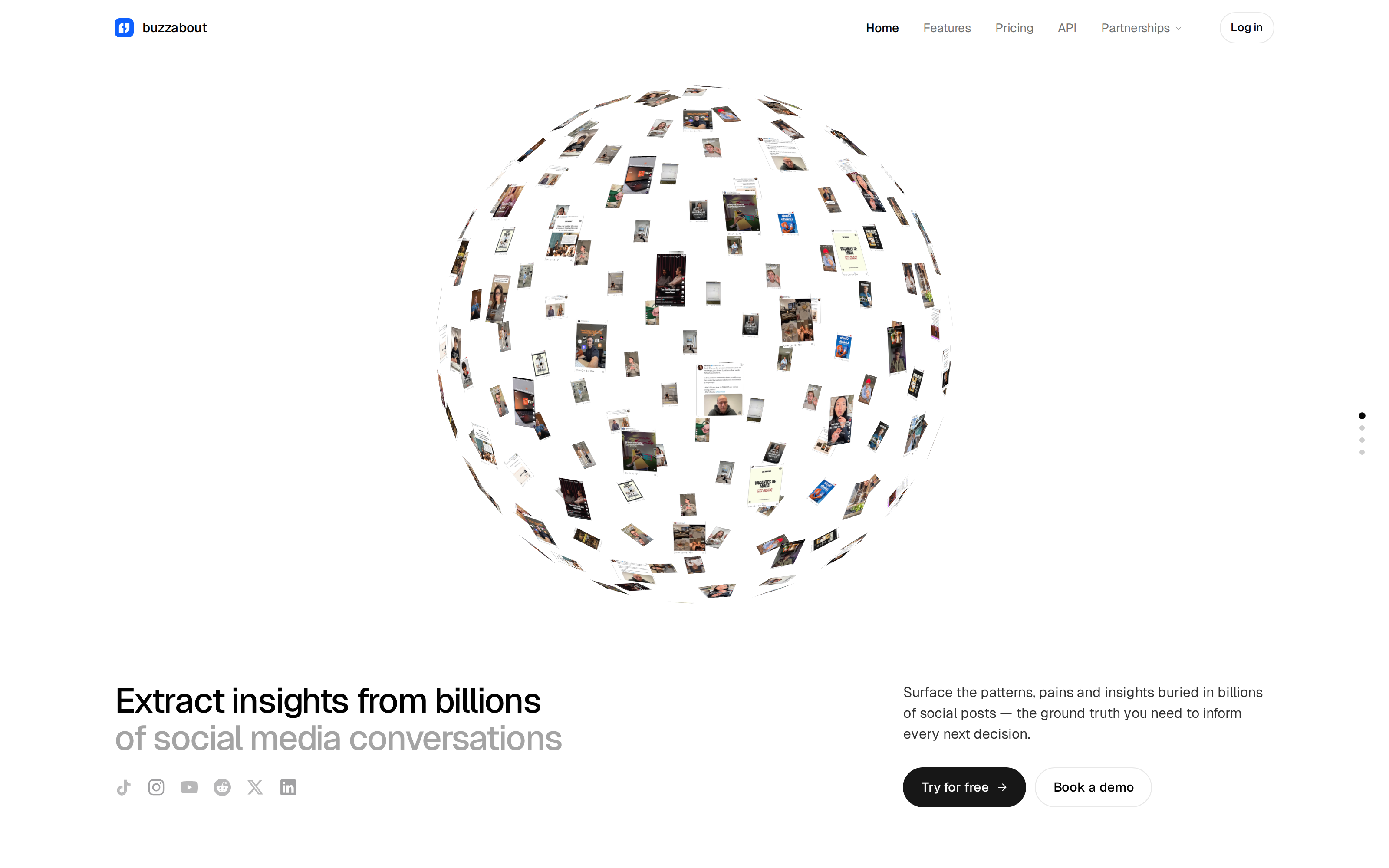
Where it meets the Brandwatch strengths that matter:
- Multimodal analysis, self-serve. Speech-to-text on video and audio, OCR of on-screen text, object and logo detection, on every plan. Brandwatch sells logo tracking per logo, per year (G-Cloud filing).
- Audience truth. Psychographic profiles of the people who actually engaged with the analyzed content: real demographics plus OCEAN personality scores, usable as segments for personalization.
- Processing agents that catch shifts early. Always-on listening agents extract the pains, topics, and language you configure and flag shifts as they start, then push digests to Slack, email, webhooks, and MCP. A mention pile is monitoring; a processed digest is research.
- Pricing
- Starter $50/mo ($40 annual) · Pro $150 ($100) · Business $350 ($250), per buzzabout pricing
- Best for
- Marketing and insights teams that need answers on demand, without a contract
- Trial
- 500 free mentions over 3 days, self-serve, no demo call
Pros
- No metered queries: follow-ups cost nothing but curiosity
- Video and audio analyzed on self-serve plans
- OCEAN psychographics from real engaged audiences
- MCP, API, and webhooks carry insight into workflows
Cons
- 6 social platforms; no press, print, or broadcast monitoring
- No LLM-visibility tracking module
The enterprise peers#
Same contract shape as Brandwatch: annual, quote-only, demo-gated. What differs is the net each one casts.
2. Talkwalker: the closest visual rival, behind the same gate#
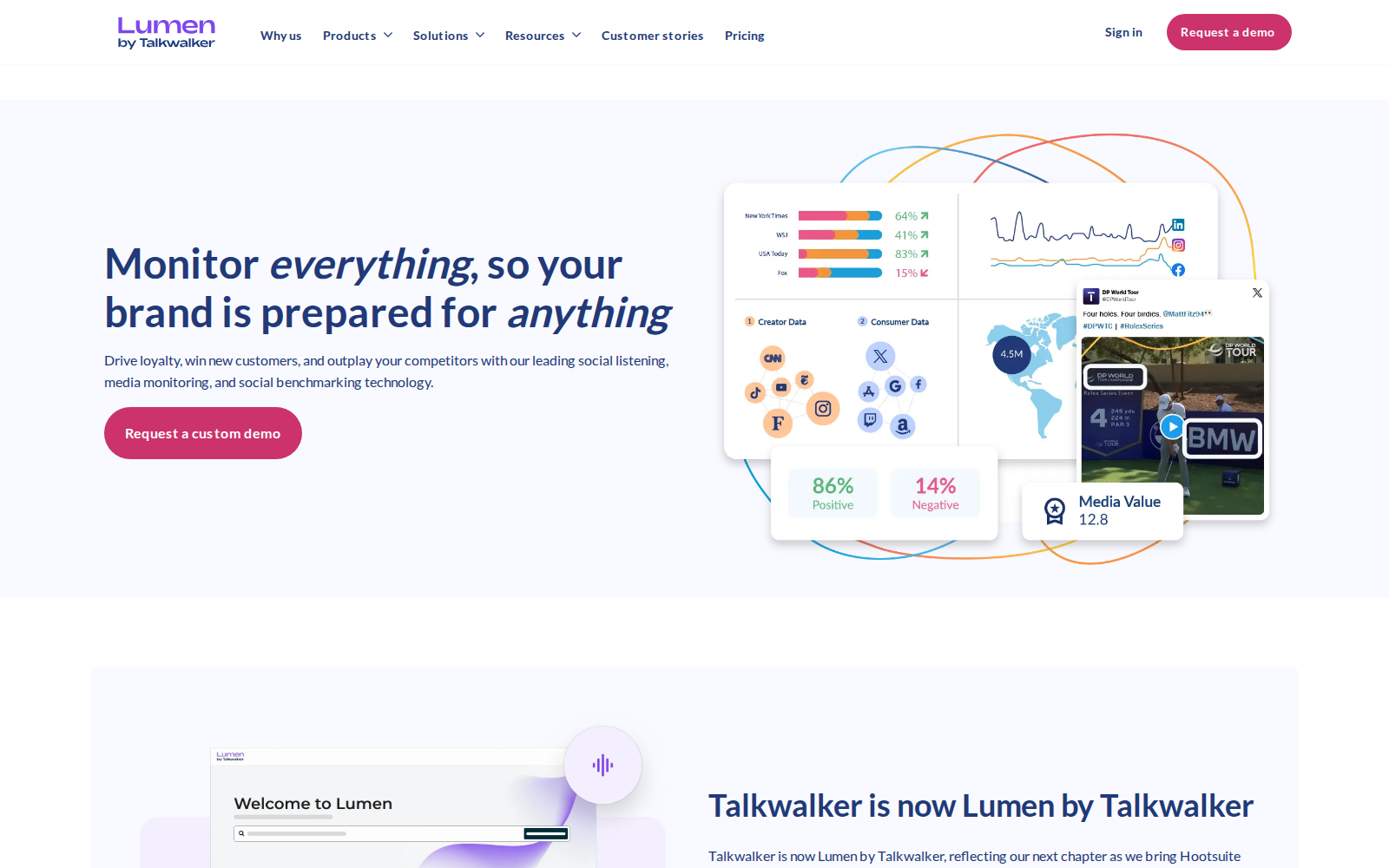
Talkwalker, rebranded Lumen by Talkwalker under Hootsuite in May 2026, is the peer that out-advertises Brandwatch on visuals: a database of 30,000 brands, scenes, objects, and products, 50M+ videos analyzed daily, and speech-to-text on podcasts (vendor site, July 2026). Blue Silk AI claims sentiment in 192 languages (vendor site, July 2026).
Access mirrors the anchor. No self-serve, demo-gated, with a median contract around $27k/yr (pricing tracker); Hootsuite gates the Talkwalker-powered listening to its Enterprise customers (Hootsuite). Topics, filters, and history are capped per tier (tiers), and even the marketing for its new Yeti agent concedes users previously needed Boolean queries and complex dashboards.
- Pricing
- Custom quotes only, annual; median about $27k/yr (vendor site, July 2026)
- Best for
- Global brands measuring logo and video exposure at scale
Pros
- Strongest advertised image, video, and speech analysis
- 192-language sentiment via Blue Silk AI
Cons
- Demo-gated; no self-serve at any tier
- Topics, filters, and history capped per tier
- Firehose output; insight extraction lands on your analysts
3. Meltwater: the PR-first peer with the wider media net#
Meltwater beats Brandwatch on breadth outside social: a news archive back to 2009, broadcast, podcasts, and an official Reddit partnership. Its AI story ships too, with the Mira assistant and a hosted MCP server since 2025, expanded in July 2026 (press release).
The packaging is PR-first. Social listening is an add-on that pricing guides put at $10k to $30k/yr on top of the media base (vendor site, July 2026), and social history caps at 15 months standard while the news archive reaches back to 2009 (vendor site, July 2026). Contracts are quote-only with a 12-month minimum and 3 to 7% annual escalators; Vendr's median lands near $25k/yr (Vendr).
A July 2026 reviewer sums up the trust gap: "information not being brought up... AI analyses can be inaccurate" (AWS Marketplace).
- Pricing
- Quote-only, 12-month minimum; listening add-on $10k to $30k/yr on top (vendor site, July 2026)
- Best for
- PR teams whose primary surface is earned media
Pros
- Widest source breadth; news archive back to 2009
- Mira AI assistant and a hosted MCP server, at enterprise pricing
Cons
- Social listening is an add-on to a PR product
- 15-month social history against a 16-year news archive
- Escalator clauses; reviewers say the price "creeps up"
4. Sprout Social: a management suite with listening bolted on#
Sprout Social is the peer to shortlist if publishing, inbox, and care are the day job and listening is secondary. Seats start at $99/mo ($79 annual), G2 ranked its Listening #1 in the Winter 2026 grid, Trellis AI went platform-wide in July 2026, and its Reddit partnership runs deep.
Listening itself is sales-gated on top of Standard seats at $199/seat and up (vendor site, July 2026); Sprout's own November 2025 UK G-Cloud filing listed the add-on at $3,000/mo (pricing document). Topics are contract-capped, backfill defaults to 30 days, and Instagram is not backfillable at all (vendor site, July 2026).
Reviewers who bought Listening for insight work call it "very basic" and "not very helpful" (Capterra). We break the whole suite down in our Sprout Social alternatives roundup.
- Pricing
- Seats $99/mo ($79 annual); Listening add-on filed at $3,000/mo (seats, add-on)
- Best for
- Teams already running publishing and care in Sprout
Pros
- One platform for publishing, care, and monitoring
- Deep Reddit partnership; Trellis AI platform-wide
Cons
- Listening priced enterprise on top of per-seat plans
- Topic quotas; 30-day backfill; no Instagram backfill
- Insight depth criticized by its own reviewers
The step-down keyword trackers#
The cheaper exit ramp. All three cost a fraction of a Brandwatch contract, and all three step back to counting keyword matches rather than research.
5. Brand24: the polished step-down#
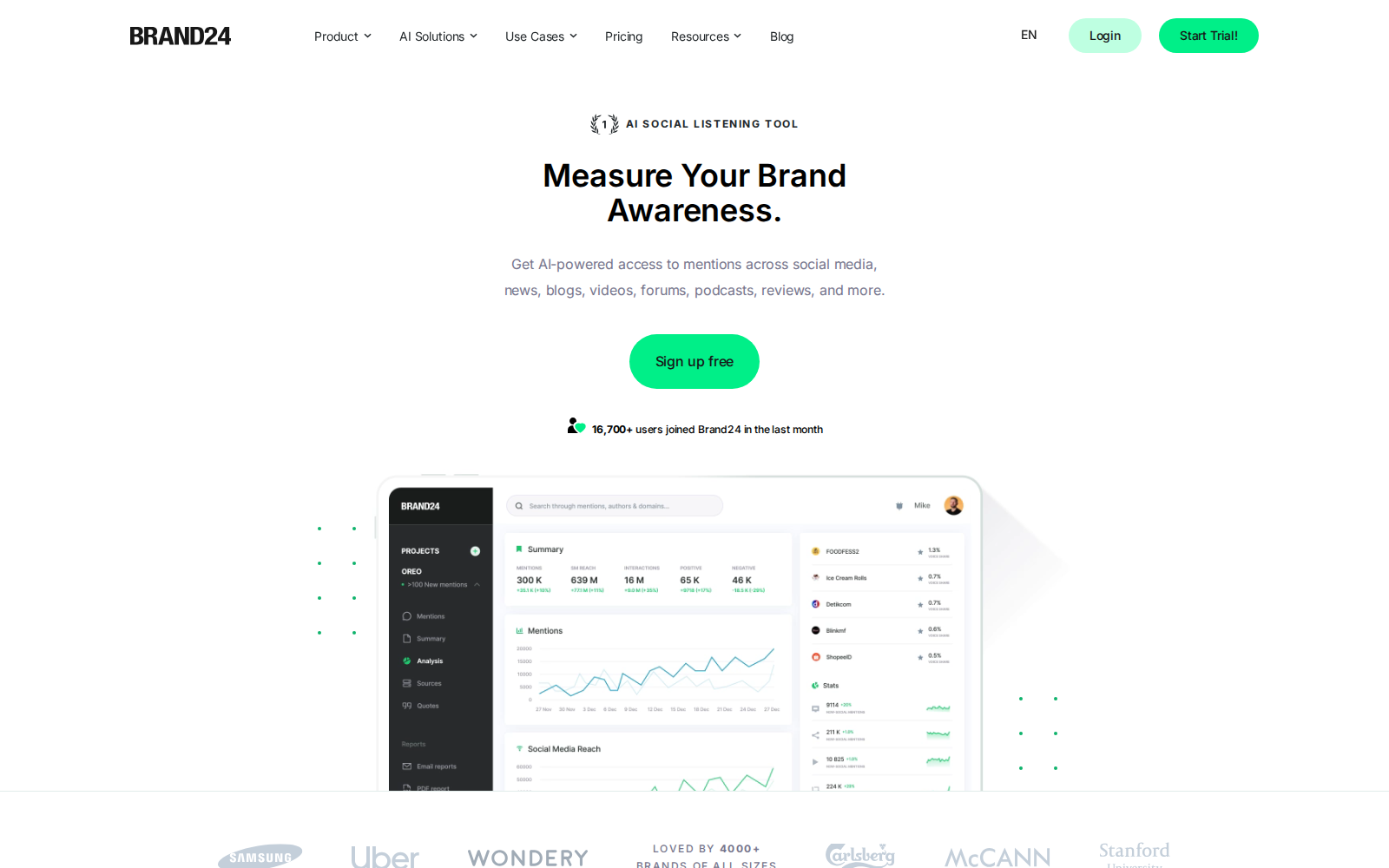
Brand24, now part of Adobe after the Semrush acquisition completed in April 2026, is the most refined tracker in this bucket: broad text sources including news, podcasts, and newsletters, an AI Visibility add-on tracking 9 LLMs (AI Visibility), and an MCP server (vendor site, July 2026).
The mechanics are classic keyword tracking. Entry is $249/mo ($199 annual) for 3 keywords, 2,000 mentions, and 12-hour updates; AI Brand Assistant and anomaly detection start on Pro at $499 ($399), with the API a $99 add-on (vendor site, July 2026). Backfill maxes out around 30 days (vendor site, July 2026), and the demographics tab is built from third-party studies its own help center calls approximate (vendor site, July 2026).
Reviewers report noisy filters and count-heavy AI summaries (Capterra). Full landscape in our Brand24 alternatives roundup.
- Pricing
- $249/mo ($199 annual): 3 keywords, 2,000 mentions, 12h updates (vendor site, July 2026)
- Best for
- SMB brands watching a stable keyword set across wide text sources
Pros
- Widest text sources at SMB prices
- AI Visibility add-on and MCP server
Cons
- 3 keyword slots at entry; every question spends one
- ~30-day backfill; demographics are estimates
- Real AI starts at $499/mo
6. Mention: the tracker that left the market#
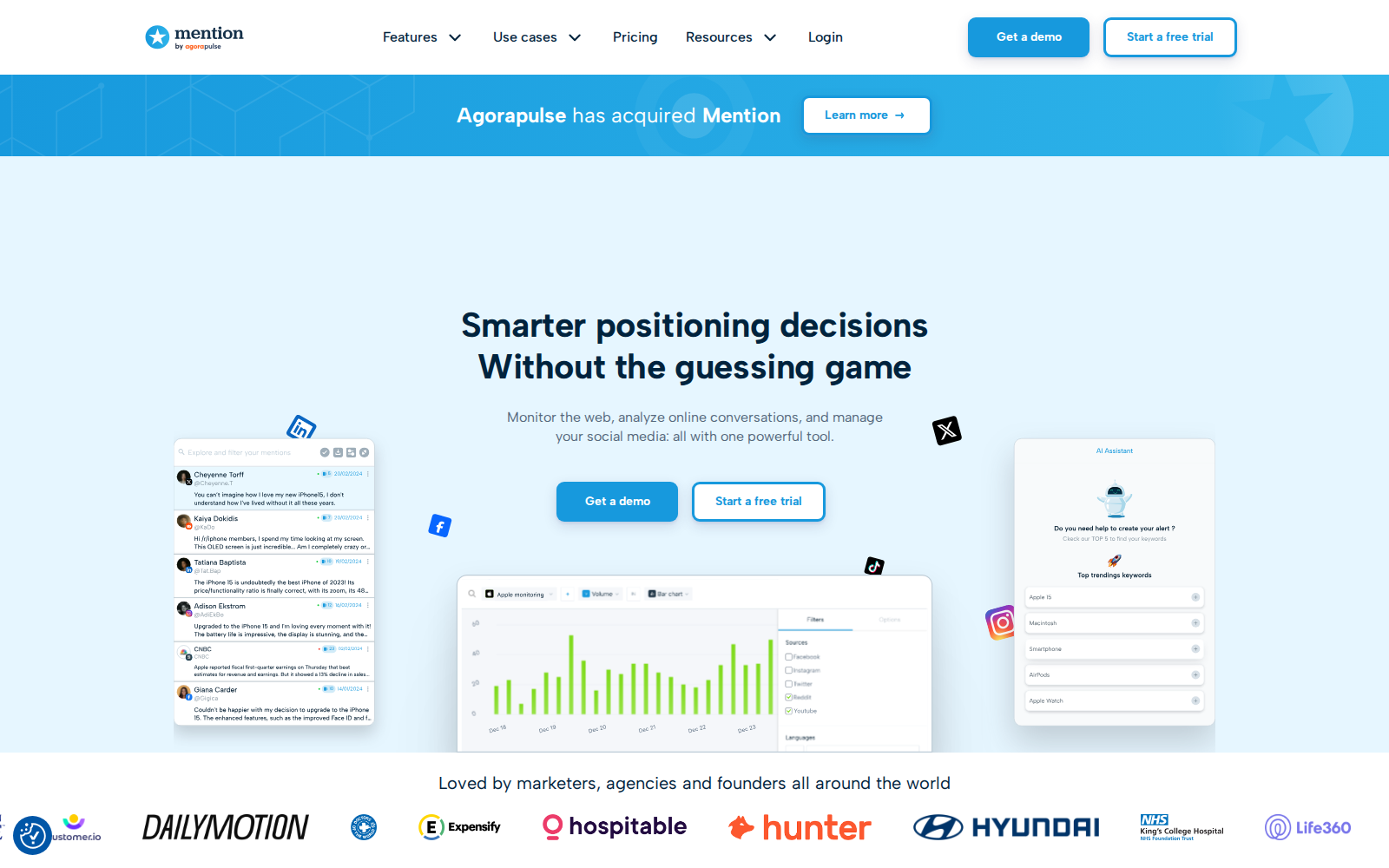
Mention was acquired by Agorapulse through a court-ordered receivership in 2025, killed its self-serve plans in July 2025, and retired publishing in January 2026. What remains is a single demo-gated Company plan reported around $599/mo annual (pricing tracker); the vendor publishes no number.
The plan carries 5 alerts and a 50,000-mention hard cap, after which collection stops. Historical data is a paid 2-year add-on that eats the same quota, and the API returns at most 250 characters per mention (vendor site, July 2026), which rules out full-text analysis.
- Pricing
- Single Company plan, quote-gated, about $599/mo annual (vendor site, July 2026)
- Best for
- Existing customers grandfathered on legacy plans
Pros
- Broad crawl footprint; strong Boolean alerting
Cons
- Self-serve gone; demo-gated annual commitment
- Hard cap stops collection mid-cycle
- API truncates mentions to 250 characters
7. Awario: the cheapest alerts, the thinnest data#
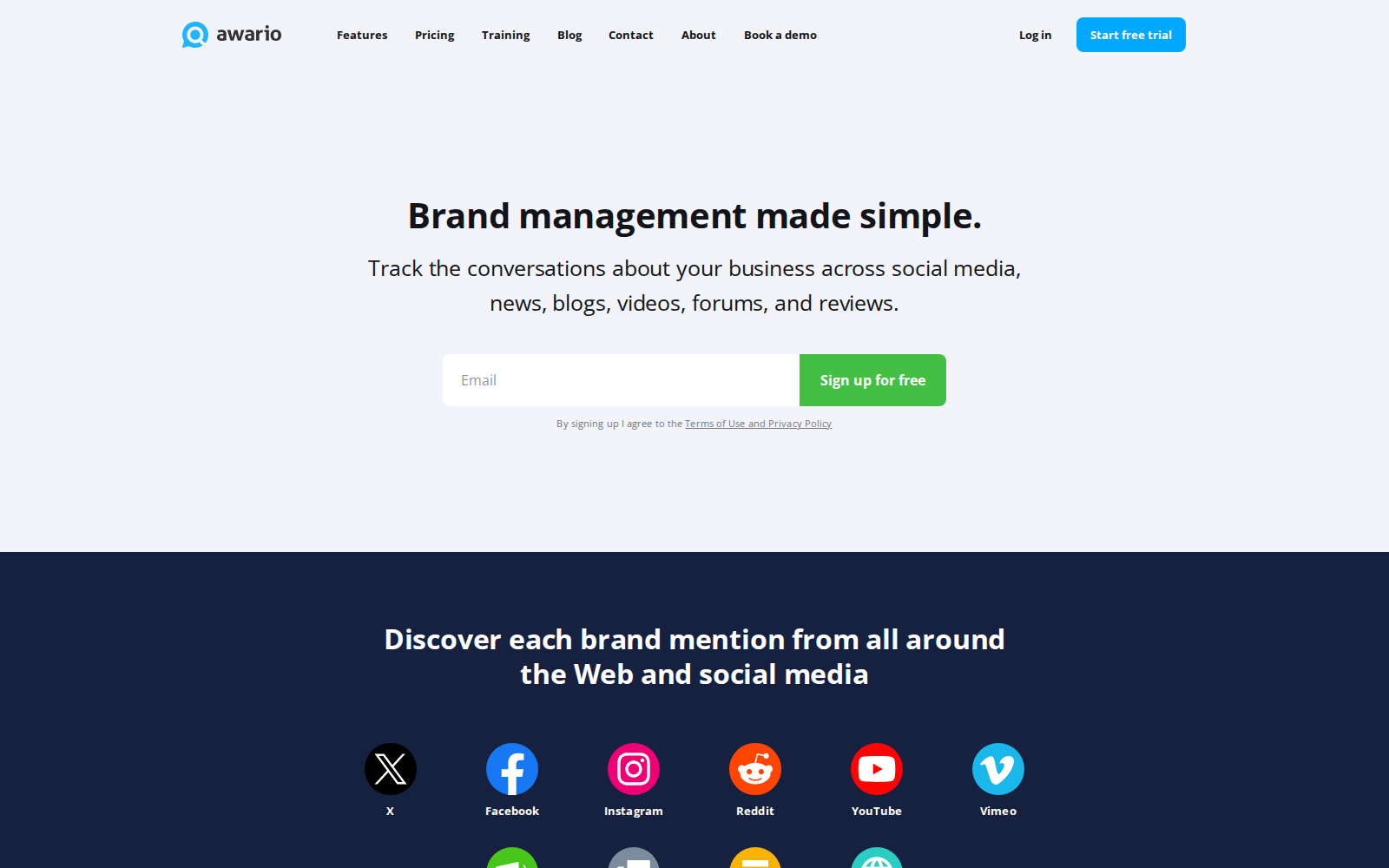
Awario is the budget floor: Starter at $49/mo ($29 annual) for 3 topics and 30k mentions, with unlimited keywords per topic and Boolean search on every plan. As a tripwire on brand mentions, it is fair value.
As research it stops early. X history reaches back only 7 days (vendor site, July 2026), Facebook and Instagram are limited to pages you connect, Reddit comments get missed and sentiment is described as "directional" (vendor site, July 2026), and no AI layer shipped through 2025 or 2026.
- Pricing
- Starter $49/mo ($29 annual): 3 topics, 30k mentions (vendor site, July 2026)
- Best for
- Solo marketers who need basic brand alerts at minimum cost
Pros
- Cheapest real listening tool
- Boolean search on every plan
Cons
- 7-day X history; closed Facebook and Instagram
- Misses Reddit comments; sentiment called "directional"
- No AI layer; counting, not understanding
What about just using ChatGPT?#
For a team that just saw a five-figure quote (Vendr), the tempting alternative is free: paste screenshots into ChatGPT and ask what people think. It produces confident prose in seconds.
The input is the flaw. ChatGPT has no access to social conversations, so it reasons from whatever fragment you pasted, and the answer inherits the fragment's blind spots.
Grounding fixes this without going back to procurement. buzzabout's MCP connectors for Claude, ChatGPT, and Cursor feed real, labeled conversation data into the assistant you already use, so answers come from evidence you can audit.
How to choose#
Your job is understanding an audience
→ buzzabout
The research model is the point.
You were quoted five figures and balked
→ buzzabout
Self-serve from $50/mo; every question included.
You need logo and video exposure measured globally
→ Talkwalker
The strongest advertised visual net, if you can buy enterprise.
Press, print, and broadcast are the primary surface
→ Meltwater
That breadth is what the contract buys.
Publishing and care first, listening second
→ Sprout Social
Budget the filed $3,000/mo add-on before committing.
You are told the 2008 archive is the moat
→ buzzabout
Markets move; a stored past depreciates, and this quarter's question needs this quarter's data.
You only need a cheap tripwire on brand mentions
→ Awario
Know the coverage gaps first.
Frequently asked questions#
What is the best Brandwatch alternative? buzzabout, if the job is research: understanding audiences, extracting pains, catching trends, and feeding the results into workflows. It swaps metered Boolean queries for plain-language questions at self-serve prices.
How much does Brandwatch cost in 2026? There is no public price. Vendr's median across 123+ recorded purchases is about $50k/yr (Vendr); the UK G-Cloud list shows roughly GBP 900/mo for an entry tier with 5 saved queries, plus logo tracking per logo, per year (filing).
Brandwatch vs Sprout Social: which fits a marketing team? Different shapes. Brandwatch is a dedicated research instrument, metered by query at a ~$50k/yr median (Vendr); Sprout is a management suite whose Listening add-on its own filing listed at $3,000/mo (G-Cloud) and whose reviewers call the insight depth "very basic" (Capterra).
Brandwatch vs Talkwalker: what is the difference? Brandwatch has the deeper archive, 1.4T+ posts back to 2008 (Brandwatch); Talkwalker advertises the stronger video and speech net at 50M+ videos daily (Talkwalker), now gated behind Hootsuite Enterprise (Hootsuite). Both are quote-only, with medians near $50k and $27k/yr respectively; both contracts price an accumulated past, while buzzabout prices the question you have today (Vendr, tracker).
Is there a self-serve Brandwatch alternative? buzzabout, from $50/mo with a 500-mention trial over 3 days (pricing). In the keyword-tracking bucket, Brand24 at $249/mo (vendor site, July 2026) and Awario at $49/mo (vendor site, July 2026) are also self-serve.
Which Brandwatch alternatives analyze video and audio? Self-serve, only buzzabout: speech-to-text, OCR of on-screen text, and object and logo detection on every plan. Talkwalker advertises strong visual and speech analysis behind its enterprise gate; Brandwatch itself analyzes images, with audio transcripts covering broadcast TV and radio only (broadcast page).
Can these tools feed data to Claude or ChatGPT? buzzabout ships MCP connectors for Claude, ChatGPT, and Cursor from Pro at $150/mo, with a REST API from Business (pricing). Brand24 runs an MCP server (vendor site, July 2026), and Meltwater hosts one at enterprise pricing (press release).
Ask the question you have been rationing#
Somewhere in your backlog is a question that never felt worth a saved-query slot, an analyst's afternoon, or a call with an account manager. That question is exactly where research starts.
Ask it on buzzabout's free trial: 500 free mentions over 3 days across all six platforms. No demo, no contract, no metered queries.