
On this page
LinkedIn social listening is reading LinkedIn posts and their comments to learn how B2B buyers talk, what they want to be seen caring about and which words earn status in their role.
The best tool for it in 2026 is buzzabout. It extracts language, priorities and pains from posts and comments instead of counting keyword mentions, then checks LinkedIn against rooms where buyers speak freely.
That check matters because a LinkedIn post carries your real name, title and employer, and your boss can see it. So people show the aspiration and vocabulary of the role, not its frustrations.
Why LinkedIn is a stage#
Media scholar José van Dijck called social media "popular stages for self-expression, communication and self-promotion," and "sites of struggle between users, employers and platform owners to control online identities." LinkedIn's interface, she wrote, "caters towards the need for professional self-promotion" (Media, Culture & Society, 2013).
Some employers write the script#
A startup employee asked Reddit what to do about a manager's request:
"I’m more annoyed at the fact that if I don’t post my manager will indeed call me to “politely” encourage me to post and spin it to say I can use it amplify my own career and accomplishments (I don’t care about using LinkedIn in this way)."
An edit at the end says how it went: "I ended up posting." A recruiter in the replies said how such posts read from outside:
"If I go to your profile, and there are a few recent posts about the company you're working for, my perception is that you're doing well, you're enjoying your job, and you're supporting the company you work for."
A recruiter's reply in the same thread
At some companies it is policy#
At one company the rule is written down. An employee in r/IndianWorkplace wrote that "every employee has to post at least 3 LinkedIn posts every month related to our work and tag the company." One reply parodied the result: "I love my company. My ceo is best leader in the world."
People polish what peers cannot check#
In a 2012 Cornell experiment, Jamie Guillory and Jeffrey Hancock had 119 undergraduates write a resume for an invented, well-paid job: as a Word document, a private LinkedIn profile or a public one (Cyberpsychology, Behavior, and Social Networking, 2012).
Overall, people lied about as often in every setting. The kind of lie changed. On public profiles, which people in their network could check, they lied less about their responsibilities and more about their interests:
The authors call the effects small, and the participants were students. The direction is still useful: people bent claims less when peers could check them, and bent the ones no one could check more.
Companies polish too#
Company Pages show the same pull. A 2025 study of LinkedIn posts by the 40 largest companies on the Johannesburg Stock Exchange found their tone overwhelmingly positive, and slightly more so where profits fell. The authors advise checking LinkedIn posts against audited statements (IJARBM, 2025).
Same search, two rooms#
Our own data shows the split. Since May 2026, a buzzabout listening agent has run one search on LinkedIn and Reddit: AI or automation, plus marketing, plus jobs or work. buzzabout labels each post's intent:
On Reddit, nearly half the posts invite replies. On LinkedIn, 41% promote or persuade, and one in ten presents the author.
What LinkedIn shows you well#
None of this makes LinkedIn useless. A stage is honest about one thing: how the performer wants to be seen. An anonymous forum cannot tell you that.
Role vocabulary#
Every role has words that sound competent, and on LinkedIn people pick them on purpose. In our AI and marketing search, LinkedIn posts lean on "AI-native" and "GTM" far more than Reddit posts do. Put the role's words on your landing page and buyers recognize themselves.
Status signals and public priorities#
LinkedIn shows what earns status in a role. In the same search, posts labeled as self-presentation announce finished AI courses, new certifications and long tenures. Each says what this buyer wants credit for, and will defend in a meeting.
Match your proof points to that currency: if buyers show off certifications, show the certification.
Practical questions, in the comments#
Comments are where peers answer back, and LinkedIn says people write and read more of them. Comments were up 37% year over year (LinkedIn newsroom, January 29, 2025), and time spent reading comments rose 18% (LinkedIn newsroom, July 29, 2026).
In our collection, comments under LinkedIn tool lists ask what the posts skip. Is this tool different from ChatGPT? Has anyone tried NotebookLM for persona development? Does anyone have an AI-generated deck they would actually use? Buyers carry those questions into a demo.
What LinkedIn hides#
The script leaves out three kinds of talk: frustration with the job, fights over budget and credit, and honest verdicts on tools. In our search, LinkedIn posts were twice as likely as Reddit posts to read as positive:
The pattern held in three other buzzabout collections that span both platforms: how marketers research audiences, AI-made UGC, and customer feedback on software. LinkedIn posts ran 73% to 87% positive. Reddit posts ran 30% to 48%.
Frustration gets rewritten#
Layoffs show the script most clearly. Emily McTiernan read LinkedIn posts by laid-off Peloton employees. Apart from a line on the layoff itself, the posts framed "the worker’s experience at Peloton in positive terms," and underplayed "anger towards Peloton or worry about being unemployed" (Flow, 2022).
In 2024, a laid-off Okta sales engineer broke the script on LinkedIn, and named it. A Reddit user shared the post:
"This is usually where people take the high-road after #layoffs and thank their company for the opportunity and how grateful they are to have worked there in the first place."
One reply enjoyed it and still called it a risk: "I live for these grumpy sales engineer posts, even if they're certainly bad for the career long term." That is the price of honesty on a stage.
Budget and credit fights stay offstage#
One r/b2bmarketing poster contrasted the keynote story of attribution with the internal one:
"All related dashboards generally mislead someone internally and/or are designed to make one part of the revenue org look better than another depending on who built the dashboard."
The same poster names the gap this guide is about: "Contrast the line by line audits against what the keynote speakers constantly reinforce." On stage, brand builds demand over time. Offstage, the CFO cuts budgets line by line.
Credit fights cost people. In an October 2026 thread on sales and marketing fighting over credit for deals, one commenter wrote: "In fact, it's such a serious problem that we've had 3 salespeople leave over the past year and a half because of it" (r/b2bmarketing). Nobody posts that under their employer's logo.
Honest tool verdicts need anonymity#
A buyer about to renew a data contract asked r/sales, in words no vendor would see on LinkedIn:
"I know zoominfo prices are essentially made up but need some feedback from the audience before I sign our renewal."
A reply explained the negotiation: "Worked for ZI. You can beat them up on price, especially if you can wait til the last day of the month." On AI tools, the candid verdict is often a shrug: "Other than copywriting help, I haven't found anything groundbreaking" (r/DigitalMarketing).
LinkedIn listening is half of B2B research#
So an honest brief needs two rooms. LinkedIn tells you how buyers want to be seen. Reddit and forums tell you what hurts, what it costs and what they would switch from.
| Reddit and forums | ||
|---|---|---|
| Who speaks | Named professionals, in front of peers and employers | Pseudonymous users, in front of strangers |
| Shows well | Role vocabulary, status, public priorities | Pains, budgets, switching stories, tool verdicts |
| Hides | Frustration, politics, honest complaints | Who the speaker is |
| Main risk | Polish, and posts written by AI | Spam and astroturf |
Both rooms reach professionals#
In Pew Research Center's 2026 survey, 51% of US college graduates said they use LinkedIn, and 36% said they use Reddit (Pew Research Center, October 2026). Pew does not measure the overlap.
AI now writes part of the stage#
An AI-detection startup estimated that over 54% of longer English-language LinkedIn posts were likely AI-generated. Wired, which reported the analysis, summed up the platform: "It’s the place where people strive to be the most anodyne versions of themselves, pleasant and inoffensive" (Wired, November 2024). Read LinkedIn alone and you get that version of your market.
How to do LinkedIn social listening in five steps#
The method works by hand or with a tool. Only the scale changes.
Step 1: Define the role#
B2B buyers are roles, not keywords. Write down the title, seniority, company size and industry you sell to.
- Pick one role per pass, such as head of demand gen.
- List the problems the role owns.
- Note who the role reports to: CMO, CFO or CEO.
- Find five to ten people in that role who post often.
The reporting line matters most on LinkedIn. It tells you who the posts are written for.
Step 2: Read posts, and especially comments#
Search the problem, not your brand. Read the top posts for the role, then spend most of your time in the comments, which are faster and closer to the work.
- Practical questions: which tool, what it cost, how they measured it.
- Pushback: peers who disagree with the post, and why.
- Stack disclosures: the tools people say they actually use.
Filter out generic comments. An r/sales poster described a LinkedIn post where "almost all 35 comments where AI comments":
"They all just rehash the post and ask a dumb generic question based on the post."
Drop comments that only praise or restate the post. What remains is your sample.
Step 3: Collect the vocabulary#
Build a glossary for the role: the nouns for the problem, the verbs for the job, the words for success. Note the room each word came from:
LinkedIn posts reach for excitement, gratitude and pride. Reddit posts say "honestly" more than twice as often, and talk more about struggle and frustration. Budget comes up at a similar rate: 6.2% of LinkedIn posts and 7.4% of Reddit posts.
Use the LinkedIn words in headlines and the Reddit words in the problem section. By hand, paste posts and comments into an LLM with this prompt:
You are a B2B market researcher. Below are LinkedIn posts and the
comments under them, written by people in this role: <role>.

1. List the 20 words or phrases the role uses for its own work.
   Quote each one verbatim, with the post it came from.
2. List the status signals: titles, awards, certificates and
   numbers people show off.
3. List the topics people put their name to in public.
4. List every practical question asked in the comments, verbatim.
5. Flag comments that look generic or AI-written, and say why.

Posts and comments:
<paste here>
Step 4: Check the claims against Reddit and forums#
Every finding from step 3 is a claim about how the buyer wants to be seen. Test it where they speak freely.
- Search Reddit for the same problem, in the role's own subreddits.
- Read forums where practitioners answer each other.
- Compare: does the pain on Reddit match the priority on LinkedIn?
- Copy budget fights, switching stories and tool verdicts verbatim.
Where the rooms disagree, you have found the gap between the public story and the private one. Good positioning speaks to the aspiration and solves the frustration. Our guides to Reddit social listening and Reddit marketing cover this room in detail.
Step 5: Profile who comments#
Under a CMO's post you may find peers, vendors, recruiters and job seekers. Their views should count differently.
buzzabout's audience research, on Pro and up, profiles the people who commented on the posts you collected, LinkedIn included. Occupation, industry, country, interests, brand affinities and OCEAN personality are AI-estimated from real public profiles.
You can then split what buyers said from what sellers said back. Our guide to audience research with AI shows how to turn profiles into copy.
Then keep it running#
LinkedIn vocabulary shifts with every hype cycle. A buzzabout listening agent processes new posts for the topics and pains you set and pushes a digest to Slack, email or a webhook.
LinkedIn social listening tools compared#
Five options, each for a different job. Prices are from vendor pages, October 2026.
| Tool | Price | What it sees on LinkedIn | Comments | Output | Who is talking |
|---|---|---|---|---|---|
| buzzabout | From $98/mo | Posts for any research question, plus 6 more platforms | Up to 100 per post | Themes, pains, quotes, live charts | AI-estimated commenter profiles (Pro+) |
| LinkedIn Page analytics | Free; paid Premium Page for more competitors | Your Page, plus competitor Page metrics | Counts on competitor Pages | Metrics, trending competitor posts | Your own followers and visitors |
| Sprout Social | From $79/seat/mo, annual; Listening sold separately | Mentions and comments on Pages you connect | On connected Pages | Inbox, publishing, reports | Not advertised for LinkedIn |
| Octolens | From $159/mo, billed annually | Keyword mentions, LinkedIn among many sources | Not advertised | Filtered alerts, API, MCP | Not advertised |
| Favikon | Free plan; Core €159/mo, billed annually | Creator accounts and their content | Not advertised | Creator shortlists, campaigns | No LinkedIn audience demographics (vendor FAQ) |
#1 · The research pick
1. buzzabout: both rooms in one question#
buzzabout is a social media research platform. It collects posts and comments from LinkedIn and the rooms where the same buyers speak freely, then extracts the themes, pains and language.
- Ask in plain language. "What frustrates heads of demand gen about attribution tools?"
- Collect both rooms. LinkedIn, Reddit and 5 more platforms, with comments.
- Get structure back. Labeled mentions, themes, sampled quotes and shareable live charts.
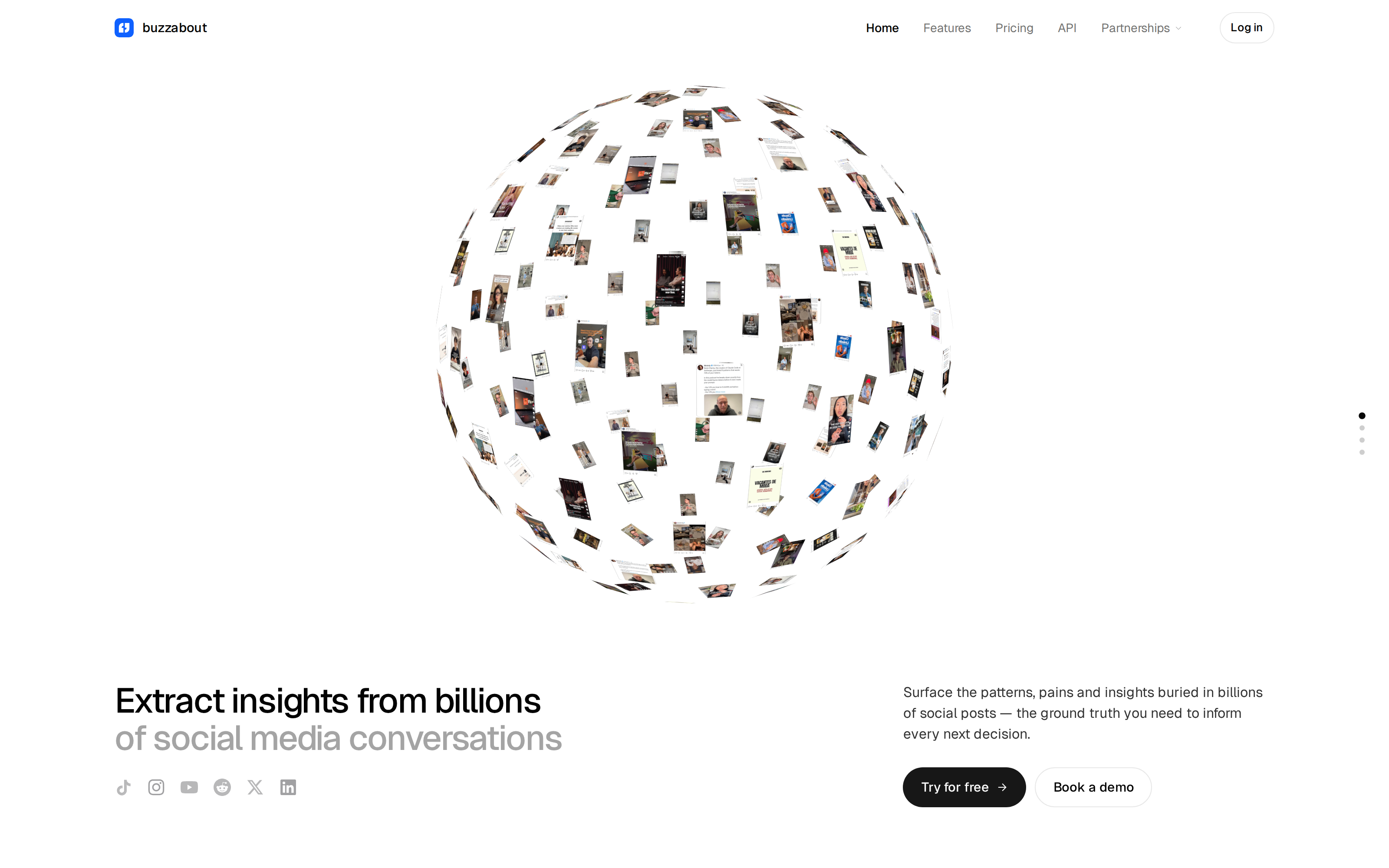
What separates it#
- Comments included. The practical questions and pushback live there.
- Labels on every mention. Intent, emotion, topic, tone and more, ready to compare.
- Who is talking. AI-estimated profiles of LinkedIn commenters, on Pro and up.
- Agents that process. New pains and topics, digested to Slack, email or webhooks.
- Into your AI tools. MCP connectors for Claude and ChatGPT on every plan.
- Pricing
- Starter $98/mo ($980/yr) · Pro $178 ($1,780/yr) · Business $450 ($4,500/yr), per buzzabout pricing
- Best for
- B2B marketers, founders and agencies who need the buyer's public words and private pains
- Trial
- Monthly plans start with a $1 one-day trial with 1,000 credits, followed by 50% off your first paid month
The same two-room comparison works on TikTok; see our TikTok social listening guide.
Pros
- Reads LinkedIn comments, not just posts: up to 100 per post
- Runs the same question on LinkedIn and Reddit, side by side
- AI-estimated profiles of commenters on Pro and up
- 7 platforms in one question
Cons
- No posting, scheduling or inbox; it will not publish to LinkedIn
- Audience research and CSV export start on Pro ($178/mo)
- Starter caps each research at 250 mentions
Built in: LinkedIn's own analytics#
Every LinkedIn Page comes with free analytics that answer one question: how is my Page doing?
2. LinkedIn Page analytics: your own Page, measured#
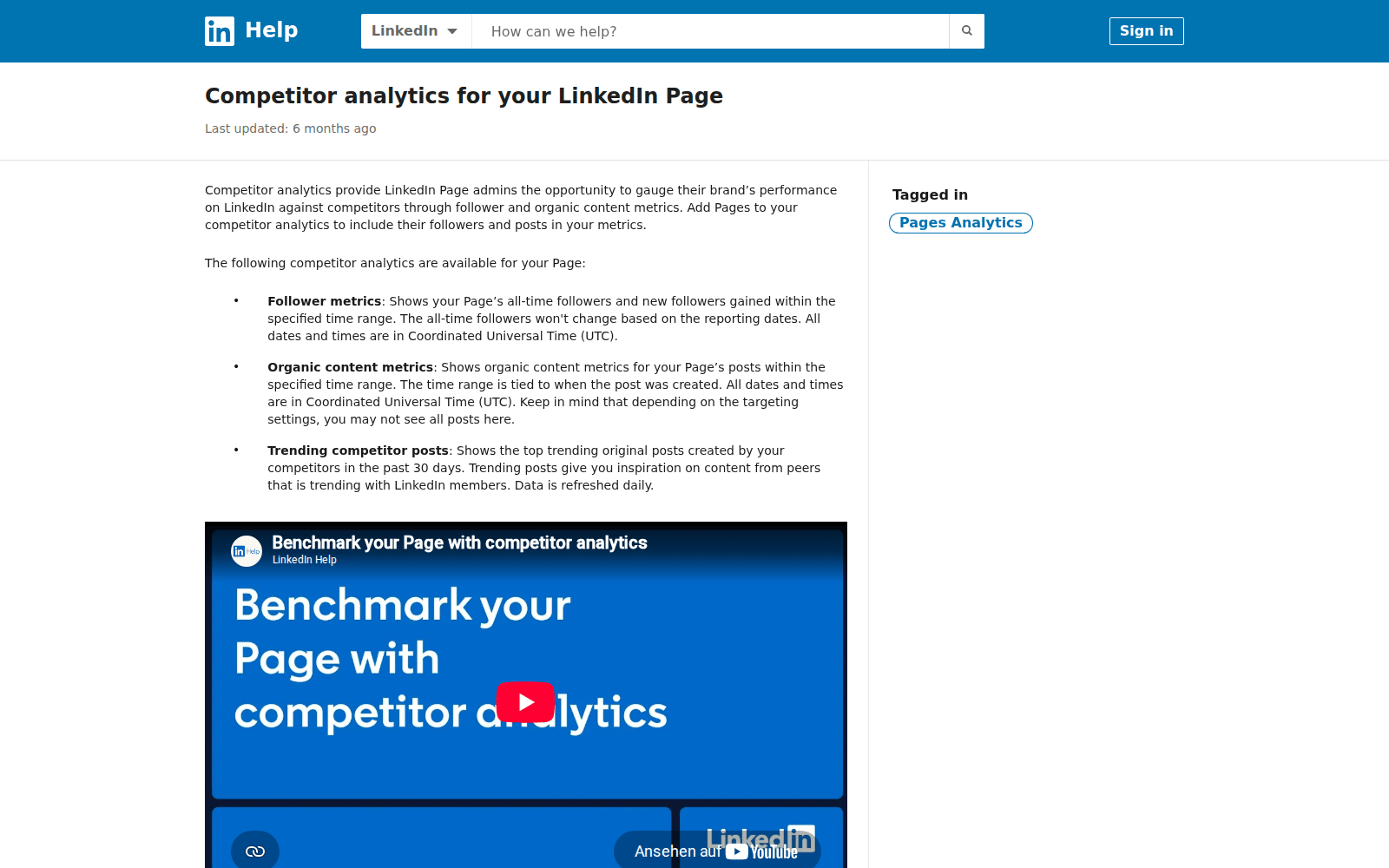
Page analytics cover content, followers, visitors, search appearances, competitors, employer brand and newsletters, for every Page admin. Follower and visitor analytics include demographics (LinkedIn Help, October 2026).
Competitor analytics compare your followers and organic content with other Pages, and show their trending posts from the past 30 days. A free Page gets data for 1 competitor; a Premium Company Page, up to 9 (LinkedIn Help, October 2026).
- Pricing
- Free for Page admins; tracking more than 1 competitor needs a paid Premium Company Page (LinkedIn Help, October 2026)
- Best for
- Measuring your own Page and benchmarking follower growth against competitor Pages
- Covers
- Your Page, plus up to 9 competitor Pages on Premium
Pros
- Free and first-party
- Follower and visitor demographics for your own Page
- Trending competitor posts from the past 30 days
Cons
- Measures Pages, not what buyers say in their own posts
- 1 competitor on a free Page
- LinkedIn only, so no check against other rooms
Suites and alerts with LinkedIn coverage#
Third-party tools differ most in what they can see on LinkedIn. Check that first.
3. Sprout Social: LinkedIn inside a management suite#
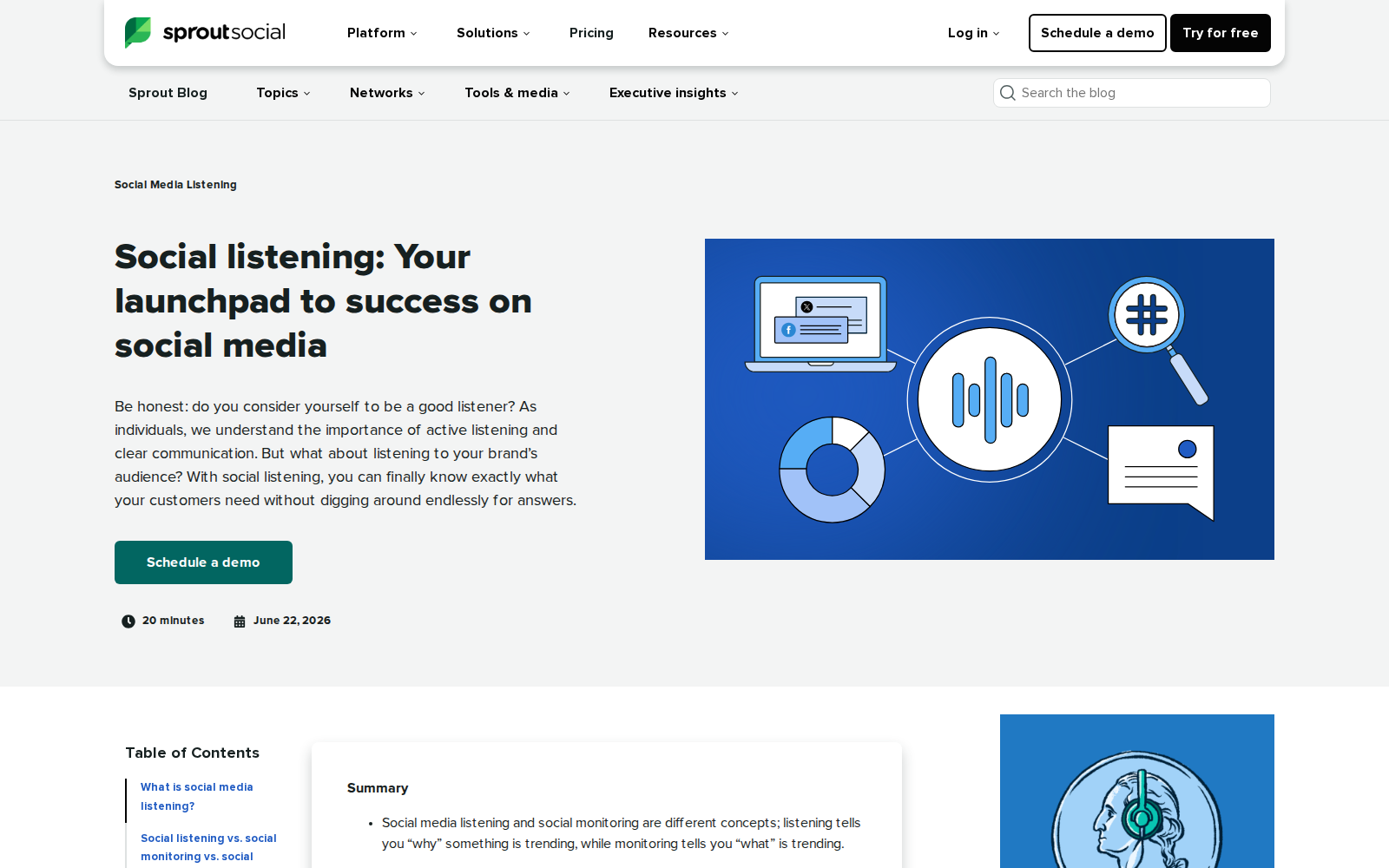
Sprout Social is a social media management suite: publishing, an inbox and reports, priced per seat. Listening is an add-on for Standard and up, sold through a demo (vendor site, October 2026).
On LinkedIn, Listening covers the Pages you connect. Sprout's help center calls this a network API limitation: "LinkedIn only allows Sprout to query the comments and mentions associated with your connected Business profiles." LinkedIn data backfills 30 days (Sprout help center, October 2026).
The pricing page lists no Listening price. Sprout's November 2025 pricing document on the UK government's G-Cloud marketplace lists it at $3,000 per month. Our Sprout Social alternatives comparison covers the rest.
- Pricing
- Essentials $79/seat/mo annual ($99 monthly) · Standard $199 · Professional $299 · Advanced $399 per seat (vendor site, October 2026)
- Best for
- Teams publishing to LinkedIn Pages and answering comments from one inbox
- Trial
- 30 days, no credit card (vendor site, October 2026)
Pros
- Publishing, inbox and reporting for your LinkedIn Pages
- Mentions and comments on connected Pages, inside Listening
- 30-day free trial with no card
Cons
- LinkedIn Listening covers connected Pages only, per its help center
- Listening is a separate, sales-gated purchase
- Per-seat pricing adds up for teams
4. Octolens: keyword alerts that include LinkedIn#
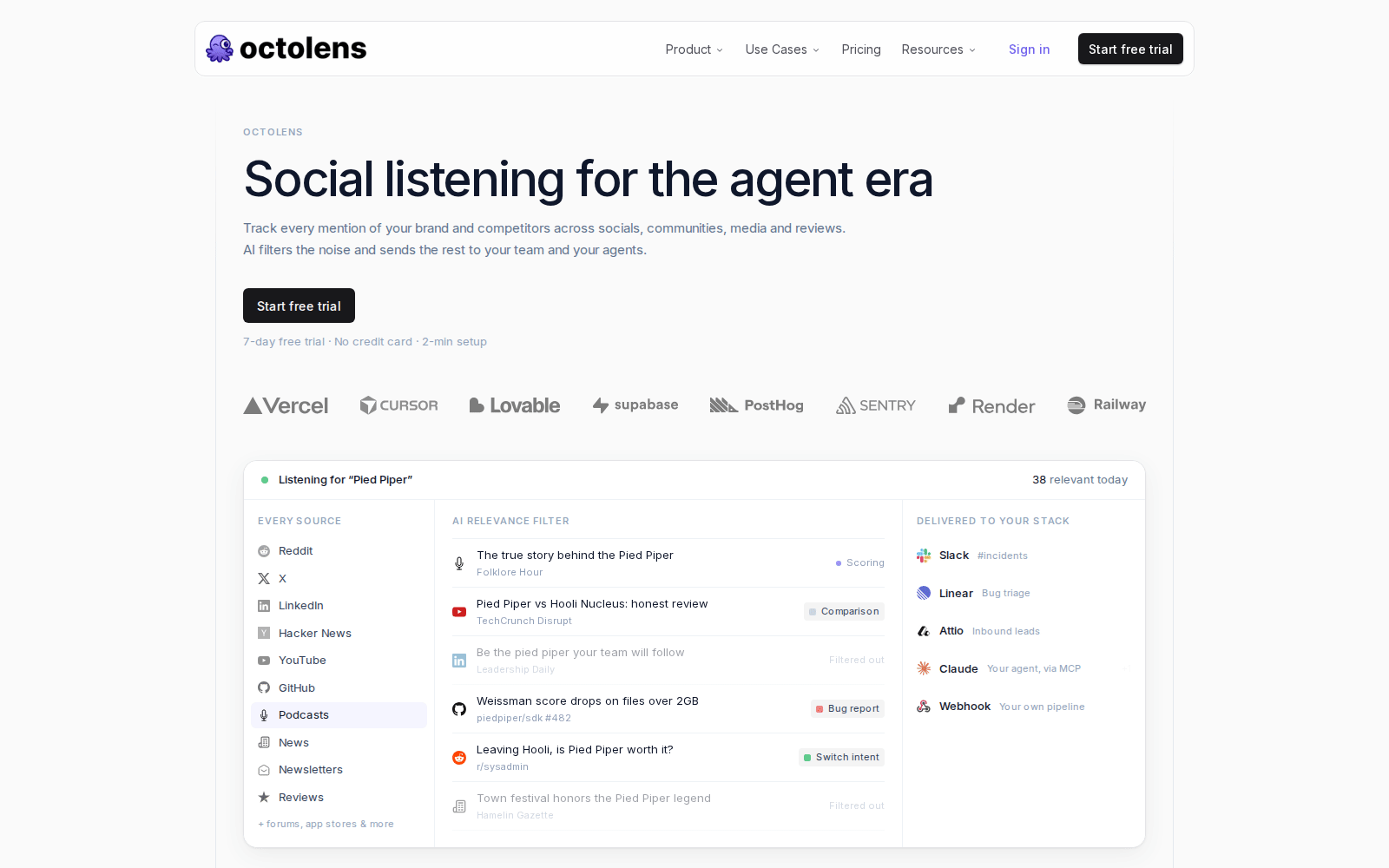
Octolens tracks mentions of your brand and competitors across socials, communities, media and reviews, with LinkedIn on every plan. It scores each mention for relevance, sentiment and intent, then sends it to Slack, email, webhooks, an API or an MCP server (vendor site, October 2026).
Pro covers 10 keywords and 15,000 mentions with hourly refresh. Scale adds podcasts, news, newsletters and the web (vendor site, October 2026).
It needs words you already know, such as your brand: a tripwire, not a study of how a role talks. Our Brand24 alternatives cover more alert tools.
- Pricing
- Pro $159/mo · Scale $499/mo, both billed annually; Enterprise custom (vendor site, October 2026)
- Best for
- Alerts when your brand or a competitor is named, routed to Slack or your agents
- Trial
- 7 days, no credit card (vendor site, October 2026)
Pros
- LinkedIn included on every plan
- API, webhooks and MCP server on every plan
- AI relevance filter cuts noisy matches
Cons
- Keyword-shaped: you must know the word first
- 10 keywords on Pro
- No commenter profiles advertised
Creator analytics#
Creator platforms answer a different question: whom should we sponsor on LinkedIn?
5. Favikon: find LinkedIn creators to sponsor#
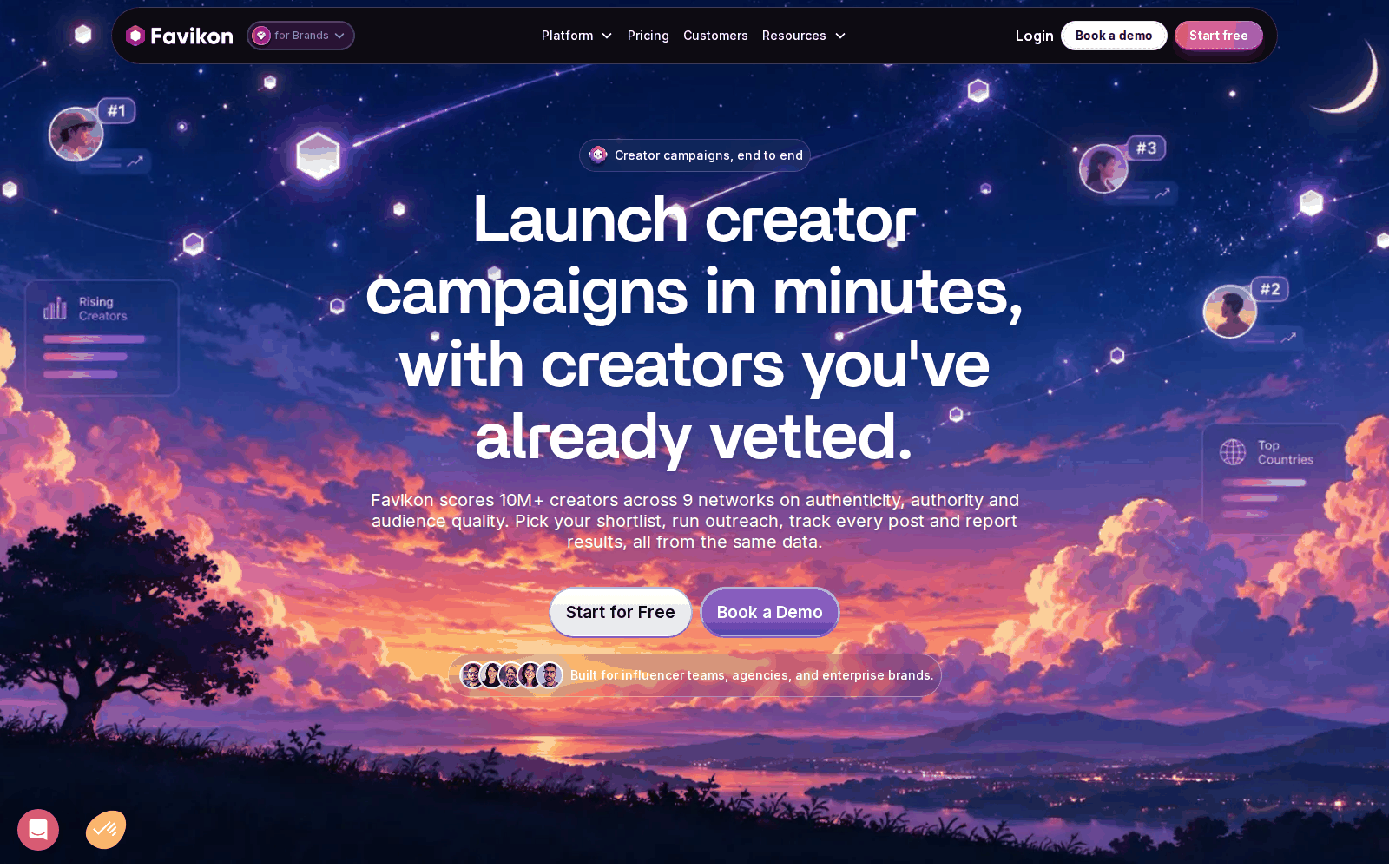
Favikon is an influencer marketing platform. It scores creators across 9 networks on authenticity, authority and audience quality, then runs outreach and campaign tracking (vendor site, October 2026).
On LinkedIn it scores authenticity, content, growth patterns and brand-deal history, but not audience demographics. Its authenticity score targets engagement pods and generic AI copy (vendor site, October 2026).
- Pricing
- Free plan (15 credits/mo) · Core €159/mo · Pro €239/mo, billed annually · Enterprise from €499/mo (vendor site, October 2026)
- Best for
- Picking LinkedIn creators to sponsor and running the campaigns
- Covers
- Creator accounts on 9 networks, LinkedIn included
Pros
- Free plan with no card
- LinkedIn authenticity scoring aimed at pods and AI copy
- Outreach and campaign tracking in one place
Cons
- Built for creator campaigns, not audience research
- No audience demographics on LinkedIn, per its FAQ
- Scores creators, not the buyers in their comments
What about just asking ChatGPT?#
An AI assistant answers fast and sounds sure. But it rests on whatever pages it retrieved, a sample you did not choose and cannot size. On LinkedIn, it summarizes the stage, with the frustration already edited out.
The fix is grounding. buzzabout's MCP connectors, on every plan, let Claude or ChatGPT answer from the posts and comments you collected in both rooms, with labels and quotes you can check.
How to choose#
You need to know how a B2B buyer talks and what hurts
→ buzzabout
LinkedIn and Reddit in one question, comments included, themes extracted.
You want numbers on your own LinkedIn Page
→ LinkedIn Page analytics
Free and first-party; it measures Pages only.
You publish to LinkedIn Pages and answer comments
→ Sprout Social
A suite with an inbox; LinkedIn Listening covers connected Pages.
You already pay for a suite's Listening add-on
→ Keep the suite for publishing, buzzabout for research
Analyst-built dashboards are now one AI prompt; the contract pays for that past.
You want an alert when your brand is named
→ Octolens
Keyword alerts with LinkedIn on every plan.
You want to sponsor LinkedIn creators
→ Favikon
Creator scoring, outreach and campaign tracking.
You need to know who comments in your niche
→ buzzabout, Pro and up
AI-estimated profiles of LinkedIn commenters.
You have one question and an afternoon
→ buzzabout, or LinkedIn and Reddit search by hand
By hand is free, and it stops scaling at the second question.
Build the B2B brief from both halves this week#
Research earns its cost when it changes what you ship. Each half of the brief feeds different work:
| Brief section | Source room | Ship this week |
|---|---|---|
| How the buyer describes the job | LinkedIn posts | Headlines and the first screen of your landing page |
| What earns status in the role | LinkedIn posts and profiles | Proof points: a result your buyer can show the boss |
| Practical questions | LinkedIn comments | FAQ entries and sales enablement |
| What hurts, in their words | Reddit and forums | The problem section, ad hooks, objection handling |
| Budget and switching stories | Reddit and forums | Pricing and comparison pages |
Gather ten quotes from each room for one role. Then run this prompt:
You are a B2B positioning strategist. Below are two sets of quotes
about the same buyer role.

Set A comes from LinkedIn posts and comments (public, named).
Set B comes from Reddit and forums (pseudonymous, candid).

1. From Set A, list the words the role uses for its own work,
   and what it wants to be seen caring about.
2. From Set B, list the pains, budget fights and tool complaints,
   quoted verbatim.
3. Where A and B disagree, name each gap in one line.
4. Write a one-paragraph brief that speaks to the aspiration in A
   and solves the pain in B.
5. Suggest three headlines in A's words that promise B's fix.

Role: <role>
Set A: <paste>
Set B: <paste>
If the gaps change your headline, the method worked. Run it again next month; both rooms move.
Frequently asked questions#
What is LinkedIn social listening? Reading LinkedIn posts and their comments to learn how a B2B buyer talks and what earns status in the role. Because posts carry a real name, pair it with Reddit and forums, where the same people discuss pains.
What is the best LinkedIn social listening tool in 2026? buzzabout, for research. It collects LinkedIn posts with up to 100 comments each, runs the same question on Reddit and five more platforms, and extracts themes, pains and language. LinkedIn Page analytics is free for your own Page.
Is there a free LinkedIn social listening tool? LinkedIn Page analytics is free for your own Page, with 1 competitor on a free Page. Searching LinkedIn by hand costs only time. buzzabout starts with a $1 one-day trial with 1,000 credits, followed by 50% off your first paid month.
Why are LinkedIn posts so positive? They are written under a real name, for colleagues and employers. In our same-search comparison, 75.1% of LinkedIn posts read as positive, against 36.9% on Reddit.
Can you see who comments on LinkedIn posts? You see names, not a summary of who they are. buzzabout's audience research (Pro and up) builds AI-estimated profiles of commenters: occupation, industry, country, interests, brand affinities and OCEAN personality.
Listen to both rooms before you write the brief#
LinkedIn tells you how your buyer wants to be seen. Reddit and forums tell you what hurts. A brief built from both can sell.
Pick one role and run both halves this week. buzzabout offers a $1 one-day trial with 1,000 credits, followed by 50% off your first paid month, on monthly plans. See pricing.
How we measured. The intent, sentiment and word charts come from one buzzabout listening agent that has run the search (ai OR automation) AND marketing AND (job OR work) on LinkedIn and Reddit since May 2026, read October 22, 2026. Shares use all posts from each platform as the base.
Intent and sentiment are buzzabout's per-post labels. The intent chart renames labels in plain English, merges "promotional" with "persuasive," and omits the small entertainment and unlabeled groups.
The sentiment chart counts "mostly positive" as positive and "slightly negative" as negative, as do the three other collections. Word shares count posts whose title or text contains each string; "any form" means the stem (struggl, frustrat). Other figures come from the sources named in the text, fetched October 2026.