
On this page
TikTok social listening is reading TikTok videos, what creators say and show, and the comments under them, to learn what a niche wants, doubts and says. The best tool for it in 2026 is buzzabout, because it transcribes the speech, reads on-screen text and collects the comments, instead of counting captions and hashtags.
On TikTok, the conversation is not in the caption. It is spoken in the video and argued in the comments. A tool that reads only captions returns a sentiment chart nobody can brief from.
What TikTok's own tools give you#
TikTok's business tools serve advertisers. Three come up when marketers ask about listening. Only one documents speech and comment data, and marketers cannot use it.
Creative Center: what is trending, ranked#
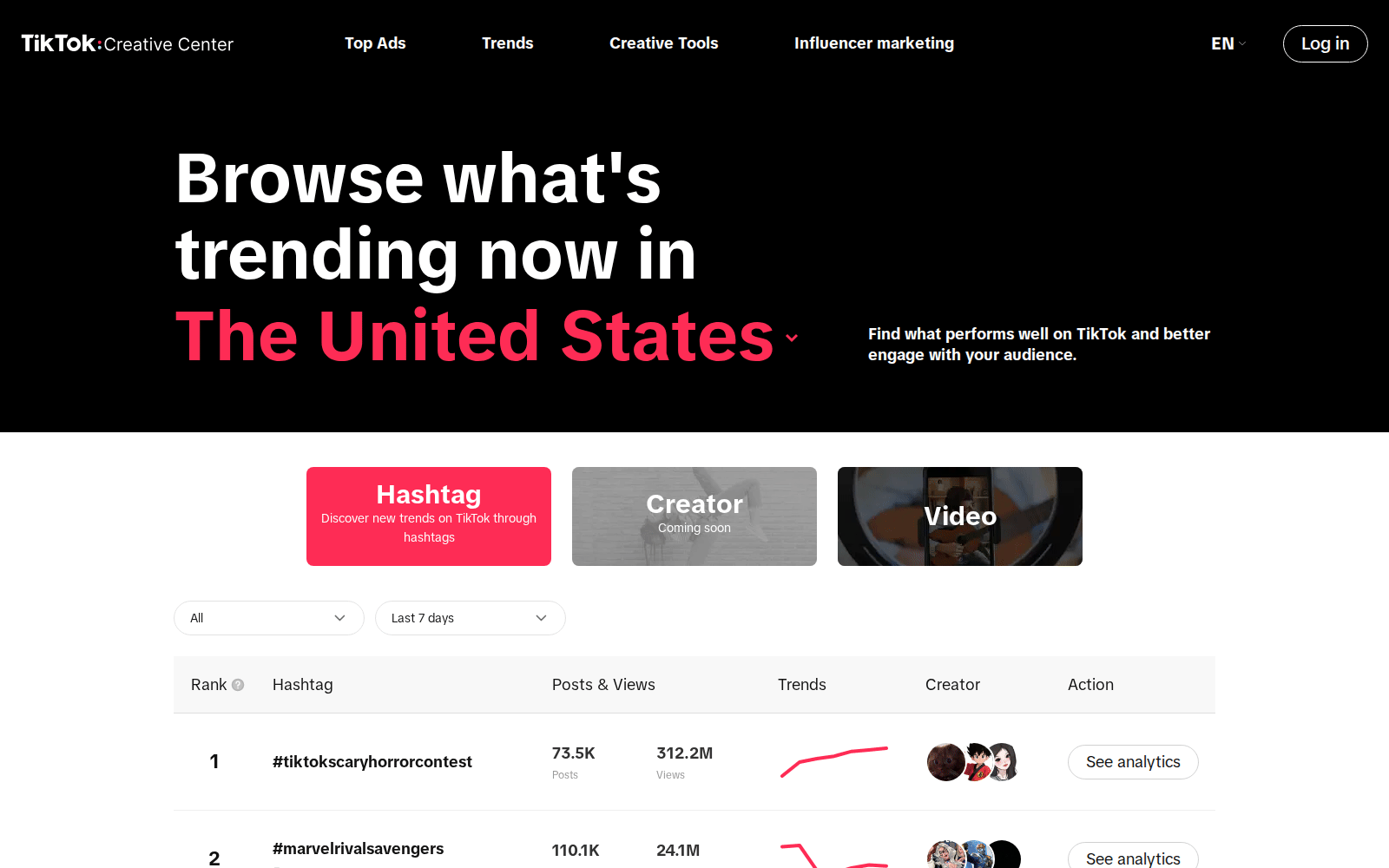
TikTok Creative Center is free. It ranks hashtags, videos and top ads by country and period: what is big this week, not what anyone said (TikTok, October 2026).
Market Scope: listening behind a sales rep#
TikTok does have a listening module. In Market Scope, a Brand perception module "functions as advanced social listening tailored to TikTok," tracking how people discuss a brand and the sentiment over time (TikTok help center, last updated February 2026).
The catch is access: "TikTok Market Scope is available for select customers," through your TikTok sales representative.
The Research API: the full data, for academics only#
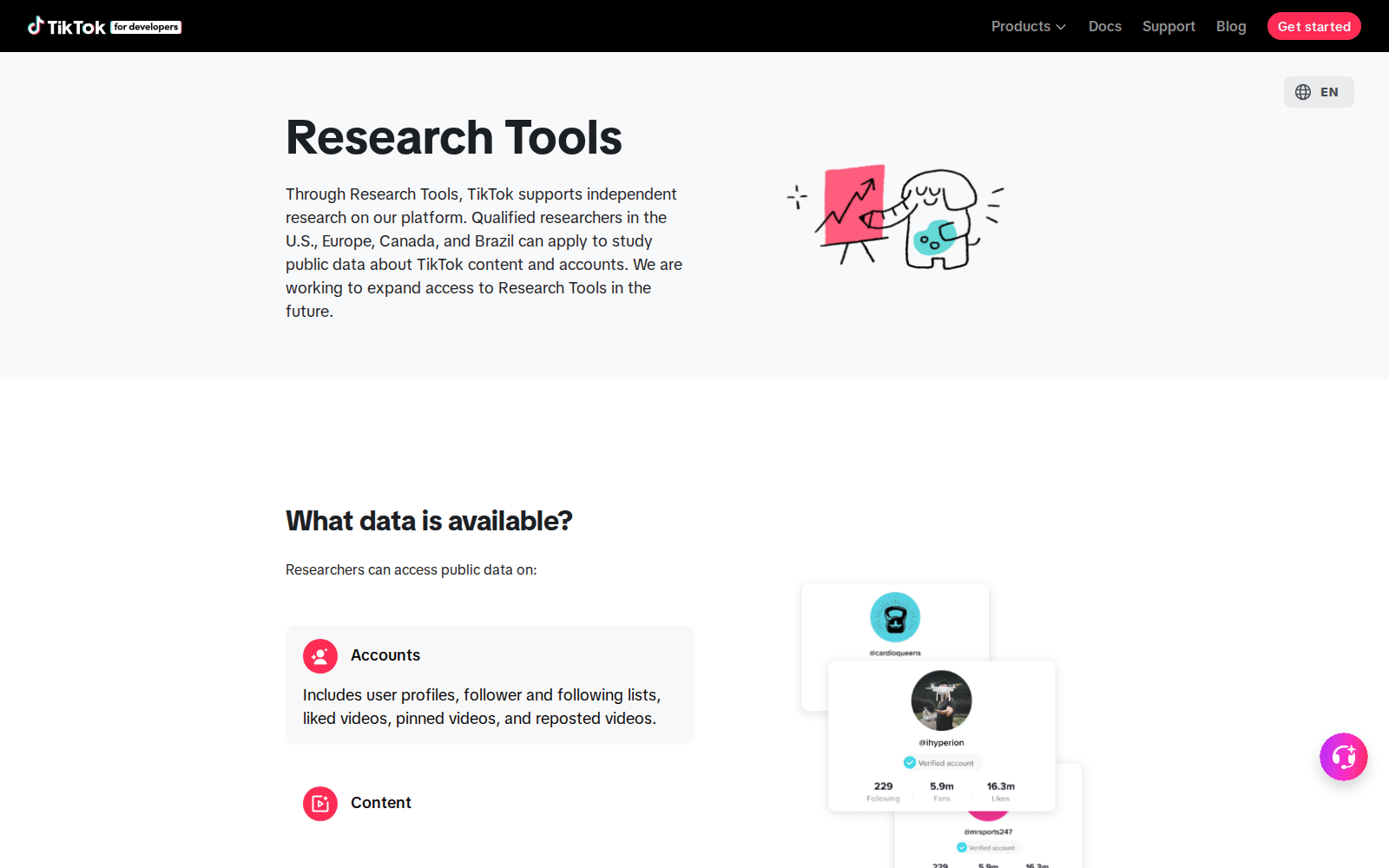
The Research API documents the layers that matter: a voice_to_text field, filled when a video has TikTok's voice-to-text on, and comments, up to 100 per request. But applicants must "Be independent of commercial interests" and pass an ethical review (TikTok for Developers, October 2026).
| Tool | Who can use it | What you get | Speech and comments |
|---|---|---|---|
| Creative Center | Anyone, free; full lists need a login | Hashtag and video rankings, top ads | No |
| Market Scope | Select advertisers, through a sales rep | Brand perception, sentiment, funnel analytics | Not documented |
| Research API | Approved academic and not-for-profit researchers | Raw videos, voice to text, comments | Yes, no commercial use |
So marketers turn to third-party tools, and the big suites document the thinnest layer.
Why caption and hashtag tracking misses the meaning#
A TikTok has four layers: the caption and its hashtags, the speech, the text on screen, and the comments. The caption is the thinnest, and on other people's videos it is where the big suites look. Sprinklr's help center says so:
"TikTok listening is limited to @mentions of authenticated business accounts and registered brand hashtags. General keyword or competitive listening is not supported."
Sprinklr help center, "TikTok as a Listening Source" (vendor site, October 2026)
Sprout Social lists TikTok coverage as "Public posts from a business page using your brand hashtag," plus comments and @mentions on accounts you connect (vendor site, October 2026).
Brand24's help center puts the problem in one line: "A lot can be said in a TikTok video without ever making it into the caption." We counted how much, in 268 creatine TikToks:
Across the 268 videos, 70% of all words were spoken, 16% sat in captions and 14% appeared on screen. A mouth tape sample of 284 videos split 73%, 15% and 12%. A caption tracker reads about a sixth of the words, and none of the comments.
The meaning is spoken#
@grace_lanker's mouth tape video, 1.3 million views when collected, is captioned "Shoutout to my gal @zoe for this hack that has saved me SO much money." The caption never names the hack.
The speech does. Mouth tape "gets expensive, now that everybody thinks it's cool," she says. Her fix is a $6 roll of kinetic tape, cut into strips, "rather than $10 for 60 pieces or whatever I was paying before."
@zummaynor's video, captioned "no gatekeeping here!!", says it in on-screen text: "the whole marketing thing is just a repackaged kinesio tape." Two creators, one finding: a mouth tape brand's rival is a cheap roll of sports tape. A caption tracker logs two #mouthtape posts.
The hook is on screen#
@joybreath.sleepbetter's video had 14.1 million views when collected. Its caption reads "Yeah… I needed a different solution," then five hashtags. The transcript is empty.
On-screen text tells the story over a man asleep with tape on his mouth, opening with the line that holds the viewer: "My husband was recently inspired to start mouth taping but we only had scotch tape..."
The argument is in the comments#
@gym_x01's video, 1.8 million views, is captioned "Because I'm kinda scared" and three hashtags. It never says scared of what. About 1,500 comments say it for her:
"yes! only if you drink enough water tho"
A comment under @gym_x01's video, 10,277 likes
"GYM GIRLS I HAVE QUESTIONS!! 1) did creatine make your acne worse? (this is mainly for those who have acne prone skin) 2) did it make your face chubby due to the bloating?"
A comment in the same thread
A caption tracker logs one post tagged #creatine. The comments hold a verdict, two objections, and a segment that names itself.
Comments also correct creators. @winlift's video weighs a supplement scoop at 3.65 grams. One reply, "Bro 5 ML is not the same as 5g," drew 1,767 likes, against about 4,000 for the video itself.
TikTok listening is creative research, not reputation monitoring#
Reputation monitoring asks whether your name came up and how people felt. An @mention feed and an inbox do that job.
Creative research asks what a niche believes, which openings make it watch, and what words it uses. On TikTok that question pays, because people go there to find things out:
In Pew Research Center's 2026 survey, 53% of US adult TikTok users said they regularly get news there, up from 22% in 2020. On TikTok, that information arrives spoken, with comments attached.
| Reputation monitoring | Creative research | |
|---|---|---|
| Starts from | Your handle and brand hashtags | A question about a niche |
| Reads | Captions, @mentions, your own comments | Speech, on-screen text, comments on any video |
| Output | Volume, spikes, a sentiment gauge | Hooks, objections, the audience's words |
| Knows who is talking | No | Profiles of the commenters |
| Ends in | A dashboard | A creator brief |
How to do TikTok social listening in six steps#
The method is the same by hand or with a tool; only the scale changes. The running example is creatine on TikTok in 2026.
- Pick the niche and the question before you collect anything.
- Collect videos with their comments, not videos alone.
- Read the transcripts and on-screen text, not just captions.
- Extract hooks, objections and the audience's words across the set.
- Profile who comments, so you know whose view you read.
- Write the brief a creator can film this week.
Step 1: Pick the niche and the question#
Start from a buyer and a decision, not your brand name. Say you sell creatine to women who lift. The question: what stops them from starting, and which openings make them watch?
- Search the words the niche uses, not your product name.
- Include formats such as "POV," "day 1" and "before and after."
- Search every language you sell in.
Languages matter: our creatine sample held videos in 16 languages, and its most-viewed video was in Portuguese.
Step 2: Collect videos with their comments#
Collect each video with its thread, and favor the most-commented: comments show where people argue. Views alone mislead; in our TikTok engagement rate benchmarks, who posted a video explained far more of its engagement than anything about the video.
By hand, you open videos one at a time and copy the top comments. In buzzabout, one question collects TikTok videos with up to 100 comments per post, and comments are not counted as mentions.
Step 3: Read the transcripts and on-screen text#
For each video, write down five things:
- The first line spoken.
- The first text on screen.
- The claim the video makes.
- The proof it shows.
- What it asks the viewer to do.
By hand, that means watching with the sound on. buzzabout transcribes every video, reads on-screen text, describes the visuals and detects objects and logos, on every plan from Starter.
Step 4: Extract hooks, objections and the audience's words#
Read the whole set for recurring openings, for fears and pushback, and for the phrases people use. Count each one. A pattern in 30 videos and one in 3 feel the same when you watch ten.
Hooks: one script, five languages#
The transcripts turned up one script in five videos. Each opens with the same question, then walks through day 1, day 7, day 14 and day 30:
| Video | Language | Views | First spoken line |
|---|---|---|---|
| @curiosidadess_semfim | Portuguese | 16.1M | "O que acontece se você tomar creatina todos os dias?" |
| @alphaworkoutofficial | English | 5.2M | "What happens if you take creatine every single day?" |
| @the_mental_armor | English | 3.8M | "What happens if you take creatine every single day?" |
| @monsieursquelette | French | 3.1M | "Que se passe-t-il si vous prenez de la créatine tous les jours ?" |
| @peterweisss | German | 1.9M | "Was passiert, wenn du jeden Tag Kreatin nimmst?" |
A tracker set to the word "creatine" matches two of these captions. The speech shows one script, beat for beat, with about 30 million views behind it.
The script also defuses an objection. At day 7 the scale jumps and the viewer panics: "I'm getting fat." Then: "Relax, it's not fat. It's your muscles pulling water in." @trainbloom's video, 6.5 million views, does the same: "Creatine for fat loss? Actually, yeah."
Objections: what the comments push back on#
Sort objections by the likes behind them. The audience has already voted:
- The water rule: "yes! only if you drink enough water tho" (10,277 likes)
- Acne: "No it gave me bacne. I stopped it." (370 likes)
- Weight gain: "I've gained a few pounds since I started with creatine" (345 likes)
- It does nothing: "Bro creatine don't do anything" (200 likes)
- Bloating: "I took creatine and my face got bloated bro" (104 likes)
The acne line is under @gym_x01's video, the weight-gain line under @naimahmalika's "Day 1 creatine" video, and the last two under @sidsfitness_30's before and after.
Comments also judge execution. Under an ASMR video of a creator chewing creatine gummies, "Worst marketing ever" took 4,023 likes. The video had about 15,000.
Language: the words to put in the brief#
Buying questions are briefs the audience wrote for you:
"What's the best creatine brand for women?"
A comment under @trainbloom's video, 13,735 likes
"Would you consider doing a list of supplements that are scientifically proved to help women? There are so many and it's getting too confusing"
A comment under @dr.emily.nutrition's video, 4,521 likes
Keep the exact words: "bloated," "bacne," "scared of creatine," "gym girls." "Water retention" is the textbook term; "my face got bloated" is what a viewer stops for. By hand, paste one video at a time into an LLM:
You are a creative strategist. Below is one TikTok video: its caption,
the transcript of its speech, its on-screen text, and its top
comments, each with its like count.

1. Quote the hook: the first spoken line and the first on-screen text.
2. State the video's claim in one line, and the proof it shows.
3. List every objection, fear or correction in the comments.
   Quote each verbatim and note its likes.
4. List the questions viewers ask that the video did not answer.
5. List the exact phrases viewers use for the problem and the product.
6. Flag comments that are jokes, sarcasm or spam, and say why.

Caption:
Transcript:
On-screen text:
Comments:
In buzzabout, this step runs over the whole collection: every video is labeled for hook type, CTA, emotion, intent, topic and tone, and the research assistant finds patterns and samples quotes on request.
Step 5: Profile who comments#
The creator is one voice. The commenters are the market, and most of it never posts:
Pew found that the top quarter of US adult users by posting volume made 98% of their public videos, and about half had never posted. The rest speak in comments.
Most commenters do not name their segment the way "GYM GIRLS" does. buzzabout's audience research, on Pro and up, profiles the people who commented on your collected videos: age, gender, country, occupation, interests, brand affinities and OCEAN personality, AI-estimated from real public profiles.
Step 6: Write the brief#
Research earns its cost when it changes what you ship: here, a brief a creator can film, every line traced to a video or comment. The template below builds one.
Then keep it running: a buzzabout listening agent processes new videos for the hooks, objections and topics you set, and sends a digest to Slack, email or a webhook.
TikTok social listening tools compared#
| Tool | Price | Speech | On-screen text | Comments | Output |
|---|---|---|---|---|---|
| buzzabout | From $98/mo | Transcribed | Read | Up to 100 per post | Hooks, objections, quotes |
| TikTok Creative Center | Free | No | No | No | Trend rankings |
| TikTok Research API | Free, research only | Voice-to-text field, when on | Not documented | Yes | Raw data |
| Sprout Social | $199/seat/mo billed annually, plus add-on | Not documented | Not documented | Your own videos | Reports, inbox |
| Sprinklr | Quote only | Not documented | Not documented | @mentions of you | Dashboards |
| Brand24 | From $199/mo billed annually | Keyword matches, profiles you add | Not documented | Not documented | Keyword mentions |
"Not documented" means the vendor's TikTok coverage pages, read in October 2026, do not list it. Market Scope is left out: its coverage is not public.
#1 · The research pick
1. buzzabout: TikTok research that reads every layer#
buzzabout is a social media research platform. There is no keyword project to set up and no social account to connect. You ask a question, and it runs the six steps above.
- Ask in plain language. "What stops women who lift from trying creatine?"
- Collect the videos. TikTok and 6 other platforms, up to 100 comments per post.
- Get structure back. Transcripts, on-screen text, hook labels, themes, quotes and live charts.
What separates it#
- Every layer read. Speech transcribed, on-screen text read, visuals described.
- Comments collected. Objections and buying questions live in the thread.
- Labels on every video. Hook type, CTA, emotion, intent and tone, ready to filter.
- Who is commenting. AI-estimated profiles of TikTok commenters, on Pro and up.
- Agents that process. New hooks and objections, digested to Slack, email or webhooks.
- Into your AI tools. MCP connectors for Claude and ChatGPT on every plan.
- Pricing
- Starter $98/mo ($980/yr) · Pro $178 ($1,780/yr) · Business $450 ($4,500/yr), per buzzabout pricing
- Best for
- Marketers, creative strategists and agencies who brief creators from what a niche says
- Trial
- Monthly plans start with a $1 one-day trial with 1,000 credits, followed by 50% off your first paid month
Pros
- Reads speech, on-screen text and comments, not just captions
- Hook, CTA and emotion labels on every video, from Starter
- AI-estimated commenter profiles on Pro and up
- 7 platforms in one question, TikTok included
Cons
- No posting, scheduling or comment replies
- Audience research and CSV export start on Pro ($178/mo)
- Starter caps each research at 250 mentions
TikTok's own free tools#
Both come from TikTok, and both are free. One ranks what is popular; the other holds the full data, behind an academic application.
2. TikTok Creative Center: free trend rankings#
Creative Center ranks trending hashtags and videos by country and period, and Top Ads shows "high-performing auction ads" with like counts and CTR bands. It does not open the videos: no speech, on-screen text or comments (TikTok, October 2026).
- Pricing
- Free (TikTok, October 2026)
- Best for
- A free weekly check on trending hashtags, videos and top ads
- Access
- Open; full lists need a TikTok for Business login
Pros
- Free and first-party
- Country and period filters
- Top Ads shows like counts and CTR bands
Cons
- Rankings only: no speech, on-screen text or comments
- Logged out, each list stops after a few rows
- Creator rankings still "Coming soon"
3. TikTok Research API: full data, academics only#
The Research API returns public videos, comments and accounts. It accepts academic institutions in the US, EEA, UK, Canada and Switzerland, and some not-for-profit bodies, with an answer in about four weeks (TikTok for Developers, October 2026).
- Pricing
- Free (TikTok for Developers, October 2026)
- Who can apply
- Academic and not-for-profit researchers, non-commercial only
- Data
- Videos with voice to text where enabled, comments, accounts
Pros
- First-party, with voice to text and comments
- Free for approved researchers
Cons
- No commercial use, so brands and agencies are out
- Application, ethical review and about four weeks' wait
- Raw data only: you write the code and the analysis
Suites that cover TikTok#
These three are built for other jobs: publishing, customer care and keyword alerts. Each documents narrower TikTok coverage. Use them for those jobs, beside research.
4. Sprout Social: publishing and replies on your own TikTok#
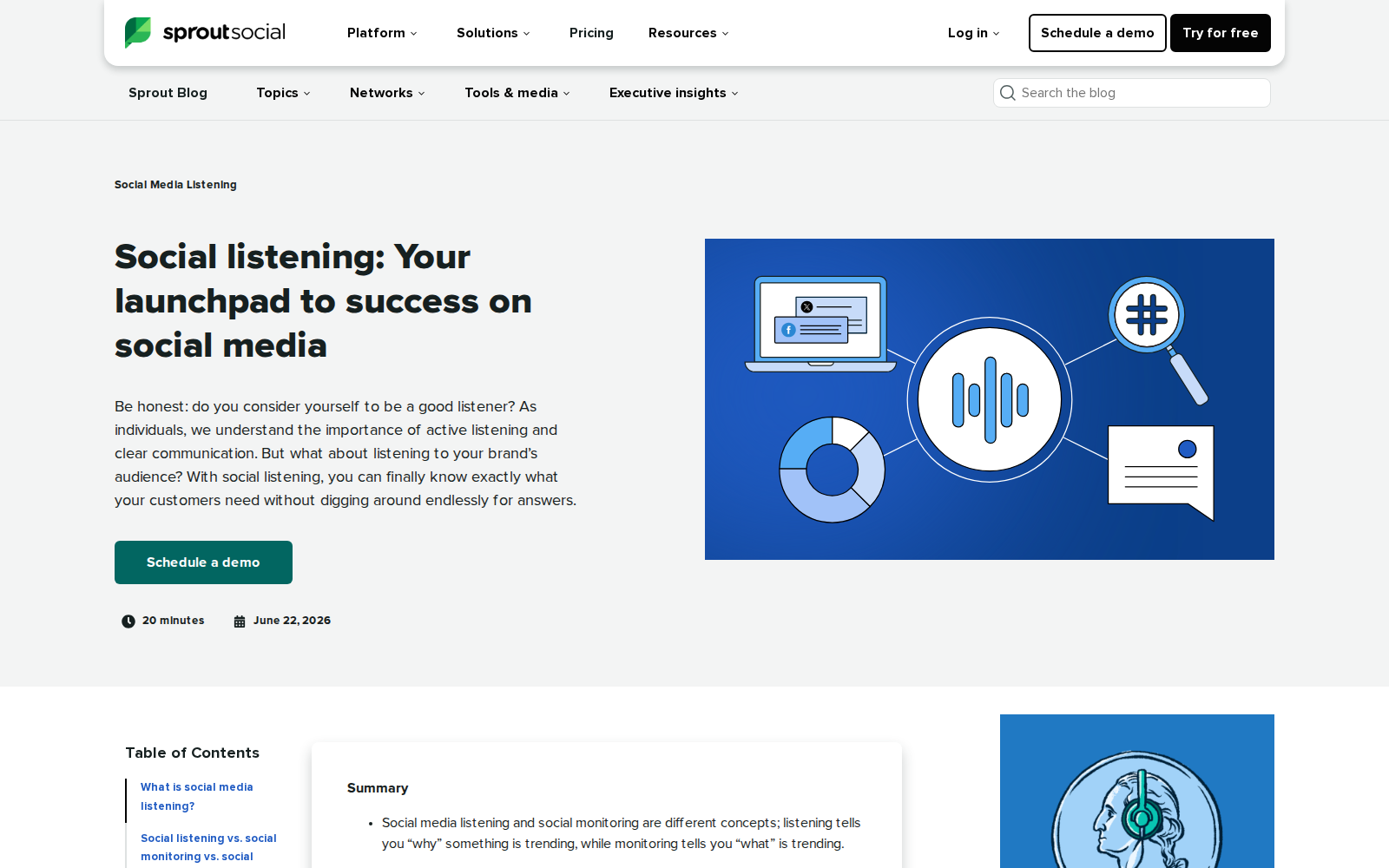
For TikTok, Sprout Social's listening help page lists brand-hashtag posts, plus "Comments on owned videos, @mentions in captions, @mentions in comments" for accounts you connect (vendor site, October 2026).
Standard is $199 per seat a month, Professional $299 and Advanced $399, billed annually, with a 30-day trial. Listening is an add-on to Standard and up, priced by demo. Vendr's median contract is $18,980 a year. See our Sprout Social alternatives.
- Pricing
- Standard $199, Professional $299, Advanced $399 per seat/mo, billed annually; Listening add-on from Standard, by demo (vendor site, October 2026)
- Best for
- Teams that publish to TikTok and reply to comments on their own videos
- Trial
- 30 days, no credit card (vendor site, October 2026)
Pros
- Publishing, inbox and replies in one place
- Comments on your own TikTok videos land in the inbox
- Public seat prices and a 30-day trial
Cons
- TikTok listening documented as brand hashtags and your own account
- No speech or on-screen text in its TikTok coverage table
- Listening is an add-on priced by demo
5. Sprinklr: enterprise care around your TikTok account#
On TikTok, Sprinklr collects "@mentions of your authenticated TikTok Business Account in videos and comments," and videos with "your registered brand hashtags in the video caption" (vendor site, October 2026).
Self-serve was discontinued and its service ended on April 30, 2026 (vendor site, May 2026), so every plan runs through sales. Our Sprinklr alternatives splits the field by job.
If you already pay for it, keep it for care. For research, its analyst-built dashboards are now one AI prompt, and its archive ages as the market moves: the contract pays for that past.
- Pricing
- Quote only; self-serve discontinued, service ended April 30, 2026 (vendor site, May 2026)
- Best for
- Enterprise care teams handling mentions of their own TikTok account
- Trial
- Demo first
Pros
- Real-time capture of @mentions of your TikTok account
- Mentions, cases and care in one enterprise platform
- Flags creators who mention your handle, for partnership outreach
Cons
- "General keyword or competitive listening is not supported" on TikTok
- Earned coverage needs registered brand hashtags in captions
- Sales-led, with no public price
6. Brand24: keyword alerts, now with spoken keywords#
A Brand24 help article dated September 9, 2026 says a TikTok can now appear "even if the keyword isn't included in its caption," when the keyword is spoken (vendor site).
The catch: it works only "for monitored TikTok profiles when captions are available for the video," meaning TikTok's subtitles. Individual is $199 a month billed annually, for 3 keywords and 2,000 mentions, with a 14-day trial (vendor site, October 2026).
- Pricing
- Individual $199, Team $299, Pro $399, Business $599 per month, billed annually (vendor site, October 2026)
- Best for
- Keyword alerts, including spoken mentions on TikTok profiles you add
- Trial
- 14 days (vendor site, October 2026)
Pros
- Matches spoken keywords, with timestamps
- Excluded keywords apply to speech too
- 14-day free trial
Cons
- Spoken matching only on profiles you add, with subtitles available
- Keyword-shaped: it finds the word, not the objection
- Entry plan is $199/mo, billed annually
What about just asking ChatGPT?#
An AI assistant answers fast and sounds sure, but it does not watch the videos. It answers from pages it happens to retrieve, a sample you did not choose.
The fix is grounding: buzzabout's MCP connectors, on every plan, let Claude or ChatGPT answer from the videos you collected, with transcripts, comments and labels you can check.
How to choose#
You need to know what a niche says, doubts and asks on TikTok
→ buzzabout
Reads speech, on-screen text and comments; extracts hooks and objections.
You want free hashtag and video rankings for this week
→ TikTok Creative Center
Free and first-party; rankings, not conversations.
You spend heavily on TikTok ads and want funnel analytics
→ Market Scope, through your TikTok rep
Select customers only.
You need raw first-party data for an approved non-commercial study
→ TikTok Research API
Free; application, ethical review and code required.
You need to publish and reply to comments on your own videos
→ Sprout Social
Publishing and inbox; listening is an add-on.
You run enterprise customer care on TikTok
→ Sprinklr
Tracks @mentions of your account; sales-led.
You want an alert when a keyword is said on profiles you watch
→ Brand24
Spoken keyword matching on profiles you add.
You need to know who is commenting
→ buzzabout, Pro and up
AI-estimated profiles of TikTok commenters.
A creator brief template to use this week#
Run the six steps on one niche, then paste your notes into this prompt. It refuses to invent what the research does not show.
You are a creative strategist. Write a one-page creator brief for one
TikTok video, using only the research below. Quote the audience's
words exactly. Do not invent claims, numbers or testimonials.

Sections:
1. Audience: who comments in this niche, in one line.
2. Tension: the fear or doubt that stops them, in their words.
3. Hooks: three opening lines to test. Each names the tension in the
   first three seconds, spoken and as on-screen text.
4. Objections to answer on screen, in order of likes.
5. Proof to show, not say.
6. Words to use, and words or executions to avoid.
7. Call to action that answers a question viewers asked.

Research:
- Niche and question:
- Top hooks, with views:
- Objections from comments, with likes:
- Questions viewers asked, with likes:
- Exact phrases viewers use:
- Who comments:
Here is what the creatine research feeds into it, for a brand selling to women who lift:
| Brief field | From the research |
|---|---|
| Audience | Women who lift, asking each other "GYM GIRLS I HAVE QUESTIONS!!" |
| Tension | Fear of bloating, a "chubby" face and weight gain |
| Hook to test | Open on the fear, then answer it, as the day-by-day script does |
| Objections, by likes | The water rule, acne, weight gain, "does nothing," bloating |
| Proof | Grams on a scale, not a scoop; viewers caught the difference |
| Avoid | ASMR chewing: "Worst marketing ever," 4,023 likes |
| Call to action | Answer "What's the best creatine brand for women?" |
Every line traces to a video or comment above. A creator can film it, and you can show where each line came from.
Frequently asked questions#
What is TikTok social listening? It is reading TikTok videos and their comments to learn what a niche wants, doubts and says. That means the speech and on-screen text, not just the caption: in our two samples, 70% to 73% of the words were spoken.
Does TikTok have its own social listening tool? Yes, for select advertisers. Market Scope's Brand perception module is what TikTok calls "advanced social listening tailored to TikTok," with access through a sales rep. The free Creative Center ranks trends only.
What is the best TikTok social listening tool in 2026? buzzabout, for research: it collects TikTok videos with up to 100 comments each, transcribes speech, reads on-screen text, labels hooks and CTAs, and profiles commenters on Pro and up.
Is there a free TikTok social listening tool? Creative Center is free for trend rankings, and the Research API for approved non-commercial researchers. buzzabout starts with a $1 one-day trial with 1,000 credits, followed by 50% off your first paid month.
Can you find out who comments on TikTok? Not by hand at scale. buzzabout's audience research (Pro and up) builds AI-estimated profiles of the people who commented, including age, country, occupation, interests and brand affinities. They are estimates from public profiles, not records.
How is TikTok listening different from Reddit listening? On Reddit the conversation is written. On TikTok it is spoken and shown, then argued in the comments. See our Reddit social listening guide and LinkedIn social listening guide.
Read the comments before you write the brief#
A caption tells you a video exists. The speech tells you what it claims, the screen how it opens, and the comments what the audience believes.
Pick one niche and one question, and run it this week. buzzabout offers a $1 one-day trial with 1,000 credits, followed by 50% off your first paid month, on monthly plans. See pricing.
How we measured. The creatine sample is 300 TikTok posts collected with buzzabout in October 2026; the word-count chart uses its 268 videos (the rest were photo posts or had no video). The mouth tape check uses the 284 videos in a second 300-post sample. Captions exclude hashtags and @mentions, speech is each video's transcript, and on-screen text is read from its frames. The chart shows medians per video; the percentages are shares of all words. Views, likes and comment counts are as collected. Comment quotes are verbatim from comments collected with those videos, and every video link was checked live on October 22, 2026. Pew: the Social Media and News Fact Sheet (5,166 US adults, August 24 to 30, 2026) and How U.S. Adults Use TikTok (February 22, 2024). Tool facts come from TikTok and vendor pages, October 2026.