
On this page
The best Foreplay alternative in 2026 is buzzabout, because it starts an ad where buyers start: with their own problems. Foreplay organizes competitors' ads. buzzabout is a social media research platform: it extracts what your buyers complain about, object to and want, in their own words.
A swipe file shows you what competitors are saying. It cannot tell you what your buyers want to hear. And when teams swipe from the same libraries, their ads start to look alike.
This guide covers seven more tools, routed by job: free ad libraries, swipe files, ad-account analytics and ad spy databases. Prices come from vendor pages, checked in October 2026.
What Foreplay is built for#
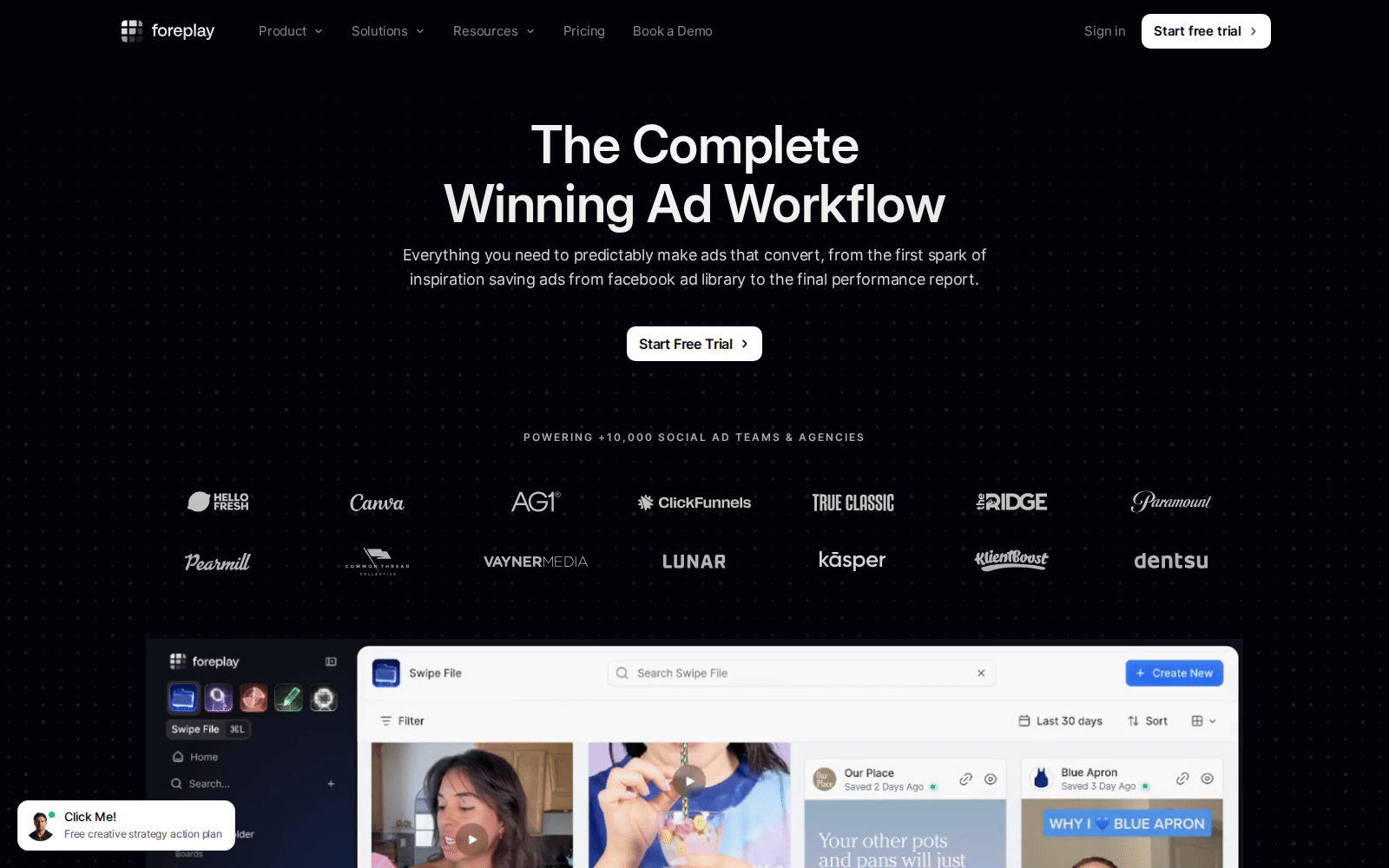
Foreplay is a creative workflow for paid social teams. It says more than 10,000 growth teams and agencies use it (vendor site, October 2026). It sells five connected products:
- Swipe File. Save ads from the Meta, TikTok and LinkedIn ad libraries.
- Discovery. Search an ad library its pricing page puts at 200M+ ads.
- Spyder. Tracks competitors' Meta ads 24/7, with up to 3 years of history.
- Lens. Creative analytics on your own ads, by brand.
- Briefs. AI scripts and storyboards built from saved inspiration.
Who it serves#
Foreplay is built for people who look at ads all day: creative strategists, media buyers and agencies. Basic is pitched to "beginners & freelancers"; Workflow adds competitor tracking and analytics for teams (vendor site, October 2026).
Users like it. G2's review summary says users "consistently praise the ease of use and clean interface" (G2).
Buyers still ask whether it is worth the money. A thread on r/FacebookAds asks it directly: "Are MotionApp or Foreplay any good?" The honest answer depends on the job.
Foreplay in October 2026: what you would be replacing#
Plans are priced by users and by how many brands Spyder and Lens cover (vendor site, October 2026):
| Plan | Monthly | Billed yearly | Users | What it adds |
|---|---|---|---|---|
| Basic | $59 | $49/mo | 1 | Swipe File, Discovery, Briefs |
| Workflow | $175 | $149/mo | 5 | Spyder tracking, Lens (1 brand) |
| Agency | $459 | $389/mo | 10 | Spyder tracking, Lens (10 brands) |
| Enterprise | Custom | Custom | Unlimited | Unlimited usage, priority support |
Extra users cost $20 each. The page conflicts with itself on Spyder's cap. Workflow's plan card says 10+ brands; its comparison table says 15. Agency shows 50+ and 50. Both agree that annual billing makes Spyder unlimited.
It also conflicts on extras. The plan cards list the Chrome extension and the MCP connection for Claude and ChatGPT from Workflow up. The comparison table ticks both on every plan, Basic included. Foreplay also lists an API.
- Pricing
- Basic $59/mo ($49 billed yearly) · Workflow $175 ($149) · Agency $459 ($389) · Enterprise custom (vendor site, October 2026)
- Best for
- Teams that save, tag and share competitors' ads every day
- Trial
- 7 days, credit card required; billing starts automatically unless you cancel (vendor site, October 2026)
Pros
- Saves ads from the Meta, TikTok and LinkedIn ad libraries
- 200M+ ad library, sortable by longest running
- Spyder keeps up to 3 years of competitor ad history
- G2 reviewers praise its ease of use and clean interface
Cons
- Competitor tracking and analytics start at $175/mo
- Trial needs a credit card and bills automatically
- Annual plans are not refunded if you cancel
- Starts from competitors' ads, not from buyers
Swipe files surface the same winners#
Swipe files solve a real problem. Ads disappear when they stop running, and teams lose track of good ones. The trouble starts when the swipe file becomes the source of the concept instead of a reference.
One shortlist for everyone#
The swipe tools share sources and a sort order. Foreplay and Swipekit save from the same public ad libraries. Foreplay, Swipekit, Atria and AdSpy all sort by the longest-running ads (vendor sites, October 2026). buzzabout sorts Meta ads by run time too.
So teams in one category open the same libraries, apply the same sort and see the same winners at the top. Then they brief variations of the same hooks. That is convergence.
Three reasons a swiped winner disappoints#
- Run time is only a proxy. Most library ads show no spend or results.
- It won for someone else. Another offer, price, audience and moment.
- Meta asks for different themes and messages. A swiped hook repeats another brand's message.
On the first point, Meta's FAQ is explicit. Every active ad shows "the ad content" and "basic information such as when the ad started running." Spend appears only for ads about social issues, elections or politics (Meta Ad Library FAQ, October 2026).
A long run means an advertiser kept paying. It does not say the ad made money, or that it would for your buyers.
Archives price the past#
A three-year history of someone else's winners shows what worked for them, then. Markets move. The buyer who clicked in 2024 may want a different promise now, and research needs this month's conversation.
Winning concepts start with the audience#
Meta has said plainly where advertisers should now put their effort. Its April 22, 2025 post on Andromeda says that with AI ad tools, "the focus has shifted from niche targeting to creative diversification as the best lever to find the most relevant audiences."
"The biggest constraint you can put on your Meta strategy is the constraints you place on your creative process."
Meta for Business, "The Creative Advantage", April 22, 2025
What Meta's own guidance says#
Meta's two best-practice posts on creative diversification spell out what it means:
- Definition. Ads "with different themes, messages, and visuals to cater to diverse audience segments."
- Volume. Keep "at least 20 diversified ads" in Advantage+ shopping campaigns.
- Cadence. Leaders "routinely launch new ads on a weekly basis."
- One method. Build "personas that outline different customer needs and blockers to purchase."
Sources: Meta for Business, April 22, 2025 and Meta for Business, November 19, 2024. The second post puts it bluntly: "Forget the idea of a 'perfect ad'."
What the engineering post adds#
Andromeda runs retrieval, the stage that selects ads "from tens of millions of ad candidates into a few thousand relevant ad candidates." Meta's engineers expect the number of ad creatives in the system "to grow significantly" (Engineering at Meta, December 2, 2024).
They also expect a future version to deliver "a more diverse set of ad candidates," and write that "increased ad diversity can improve people's experience with ads and drive better advertiser outcomes." The April post ties this to advertisers: a wider range of creatives gives "our ads system more options to work with."
A hundred cuts of one competitor's hook share a theme and a message. By Meta's own definition, that is not diversity.
Buyer needs live in conversations, not ad libraries#
Meta's November post also says to study your own top ads; Motion and Atria do that job. Its persona method starts somewhere else: customer needs and blockers to purchase. Those are not in a competitor's ad library.
They are where buyers talk to each other: Reddit threads, TikTok comments, YouTube reviews, LinkedIn posts.
So the order matters. Find concepts in the audience first. Then check them against the market, to see who already says what, and how:
| Where a concept starts | What it shows you | What it cannot show you |
|---|---|---|
| A competitor's ad | What they chose to say, and that it kept running | Whether it paid off, or would for your buyers |
| Your own ad account | Which of your past ads performed | Concepts you have not tried yet |
| Your audience's conversations | Pains, objections, desires, exact words | Whether a competitor already owns the angle |
The last row's gap is why the market check matters. It is also why buzzabout searches the Meta Ad Library: the research and the check happen in one app.
Five kinds of reason to buy#
Distinct concepts come from distinct reasons to buy. Look for five kinds in what buyers say:
- Pains. What goes wrong before they find a fix.
- Objections. Why they hesitate: price, trust, effort, past failures.
- Outcomes. What "fixed" looks like, in their words.
- Identities. Who they believe they are when they buy.
- Triggers. The moment the problem turns urgent.
Each kind can carry its own concept. Five reasons give you five ads that differ in theme and message, which is what Meta asks for.
Foreplay alternatives compared#
Prices are per month on monthly billing, from vendor pages checked in October 2026. Annual figures use each vendor's yearly billing. Offer prices are labeled. Sources are in each entry below.
| Tool | Monthly | Annual | Starts from | Trial or free option |
|---|---|---|---|---|
| buzzabout | $98 | $980/yr | Audience conversations | $1 one-day trial |
| Foreplay | $59 | $588/yr | Competitors' ads | 7 days, card required |
| Meta Ad Library | Free | Free | Competitors' ads | Free, no account needed |
| TikTok Creative Center | Free | Free | Top TikTok ads | Free; log in for all Top Ads |
| Swipekit | $39 | $312/yr | Competitors' ads | 14 days, no card |
| Atria | $179 list ($159 on offer) | $1,548/yr on offer | Competitors' ads and your ad account | Free start, no card |
| Motion | $999 | Not listed | Your ad account | Free trial, no card |
| AdSpy | $149 (introductory offer) | Not listed | Competitors' ads | None listed |
| BigSpy | $69 | $588/yr | Competitors' ads | Free plan, 10 searches a day |
The two platform libraries are free, and BigSpy has a free plan. Among paid entry plans, the spread is wide:
Atria's offer is labeled "Black Friday Cyber Monday" on its pricing page. AdSpy calls its $149 "an introductory offer" and lists no other price.
buzzabout's $98 sits in the middle, and it buys a different job. The others start from ads. buzzabout starts from buyers, across seven platforms.
#1 · The research pick
1. buzzabout: ad concepts from your buyers, checked against Meta ads#
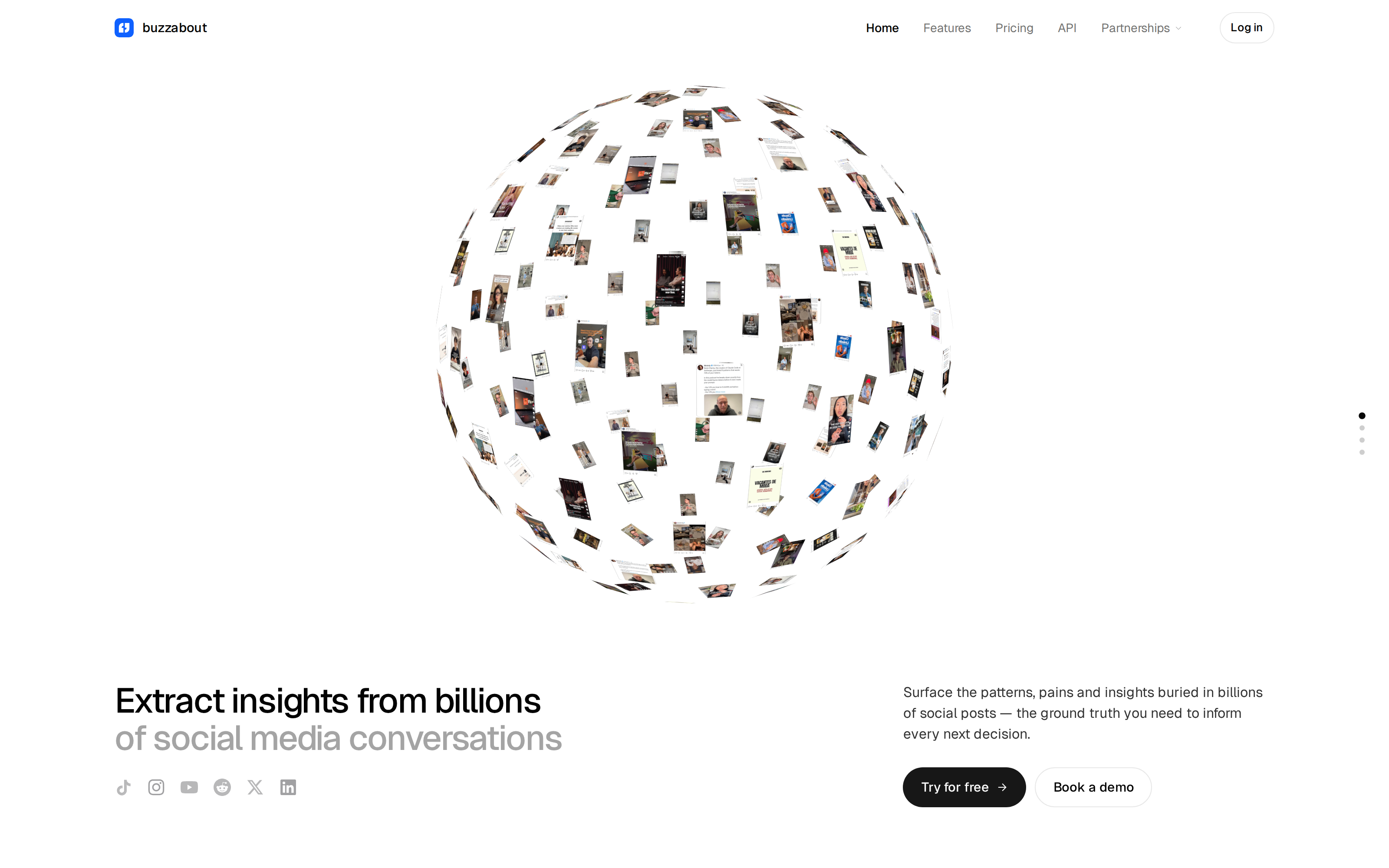
buzzabout is a social media research platform, not a swipe file. You ask a question about your buyers in plain language. It collects the conversation from Reddit, YouTube, X, LinkedIn, TikTok, Instagram and Facebook, with up to 100 comments per post.
- Ask about the buyer, not the competitor. "What stops new runners buying trail shoes?"
- Read the pains, objections and exact phrases. Labeled on arrival, sampled as quotes.
- Turn each reason to buy into a concept. One reason per ad.
- Check the market. Search the Meta Ad Library for who already says it.
What it gives a creative strategist#
- Pains and objections in buyers' words. The assistant mines patterns and samples real quotes.
- Hooks in the wild. Every post labeled by hook type, CTA, emotion and intent.
- Video read, not just captions. Speech transcribed and on-screen text read, from Starter.
- Who is talking, from Pro. AI-estimated age, occupation, interests and OCEAN personality.
- Listening agents. New pains, processed into digests for Slack, email or webhooks.
Comments matter here. They are where buyers argue, object and say what would change their mind. For TikTok, see our TikTok social listening guide. The audience research guide covers the full method.
The Meta Ad Library check, in the same place#
Since August 2026 buzzabout also searches the Meta Ad Library, for Facebook and Instagram ads, in the app and in the research assistant. Search by keyword or advertiser, then filter by country, active status and media type. Each ad shows:
- Who and where. Advertiser, landing URL and CTA button.
- How it runs. Active or ended, and its placements.
- What it is. Display format, creative format, video duration and product category.
- Reach, where Meta publishes it. EU reach, the only reach figure.
- Content labels. Hooks, CTAs and formats, labeled automatically.
Variants of one creative are grouped together. Sort ads by how long they have run, save them into collections, and have the assistant analyze them.
What buzzabout does not do#
Be clear on the gaps before you switch:
- No TikTok ads. Use TikTok Creative Center for those.
- No spend, impressions or CTR for any ad.
- No connection to your own ad account. Motion and Atria do that.
- No browser extension for saving ads.
- No automated competitor-ad monitoring. Listening agents cover organic posts only.
- No ad searches through the API or MCP. They run in the app.
- Pricing
- Starter $98/mo ($980/yr) · Pro $178 ($1,780/yr) · Business $450 ($4,500/yr), per buzzabout pricing
- Credits
- 2,000, 5,000, or 20,000 a month; 1 credit per post collected, comments not counted
- Best for
- Creative strategists who need concepts from buyers, not from swipe files
- Trial
- "a $1 one-day trial with 1,000 credits, followed by 50% off your first paid month." Monthly plans only.
Pros
- Concepts start from real pains, objections and buyer language
- Meta Ad Library search in the same app as the research
- Video transcribed and on-screen text read from the $98 plan
- Commenter profiles from Pro, AI-estimated from public profiles
Cons
- No TikTok ads, and no spend, impression or CTR data
- No swipe extension and no automated competitor-ad tracking
- Entry plan costs more than Foreplay Basic ($59/mo)
- Audience research and CSV export start on Pro ($178/mo)
The free libraries: Meta and TikTok#
These two are where the swipe tools save from. Foreplay and Swipekit both save ads out of them (vendor sites, October 2026). Use them directly before you pay for a swipe file.
2. Meta Ad Library: the free source the swipe tools save from#
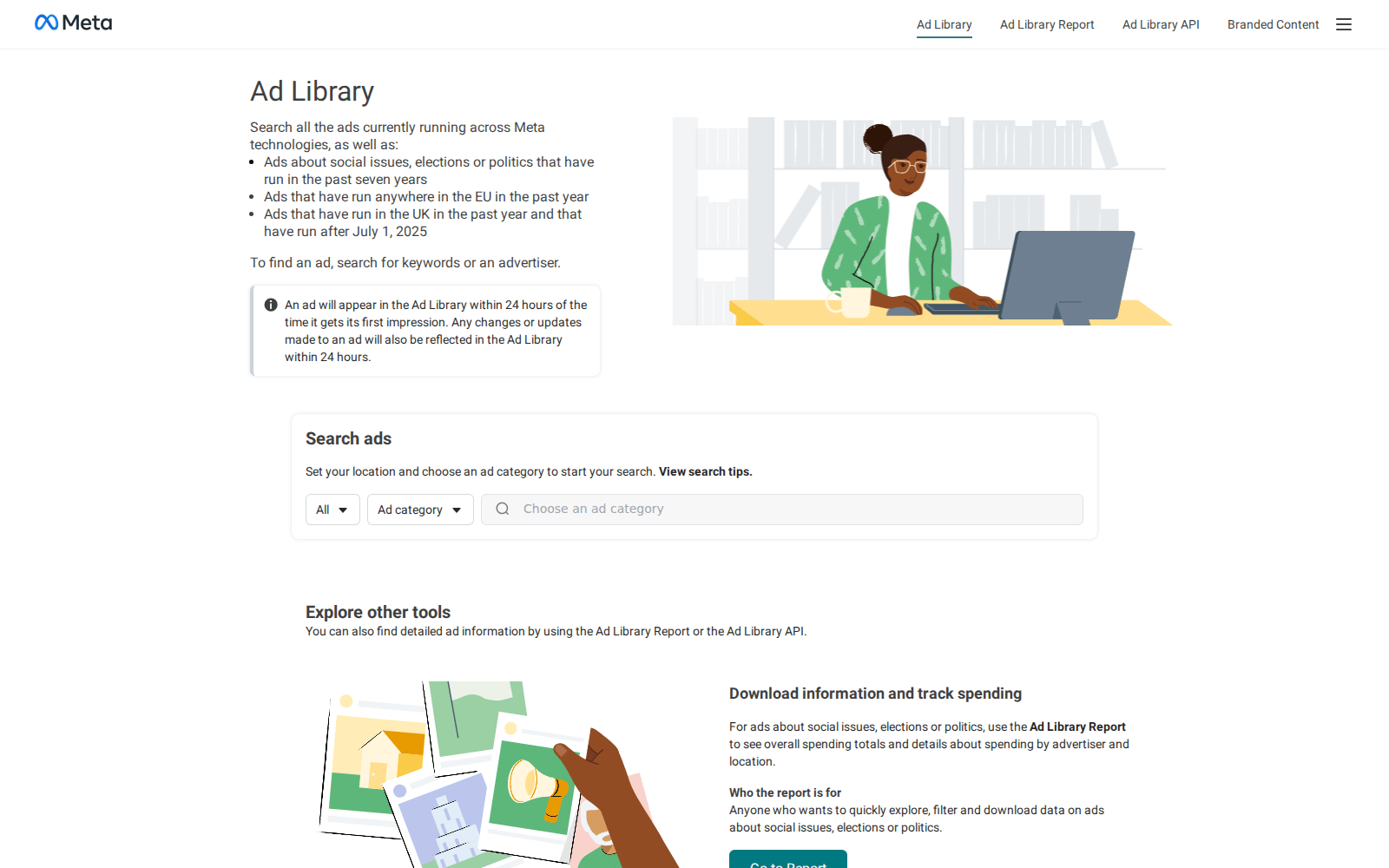
The Meta Ad Library lets anyone search "all the ads currently running across Meta technologies" by keyword or advertiser. Anyone can use it "with or without a Facebook account" (Meta, October 2026).
New ads appear within 24 hours of their first impression. Ads about social issues, elections or politics stay searchable for seven years, with spend. Ads that ran in the EU or UK stay for one year.
Everything else drops out when it stops running. There are no boards, tags or team sharing. Those gaps are what Foreplay and Swipekit sell.
- Pricing
- Free; no account needed (Meta, October 2026)
- Best for
- A free look at what one advertiser runs on Meta right now
- Trial
- Not needed
Pros
- Free, from Meta itself, no account needed
- Every active ad on Meta technologies, searchable
- An Ad Library API for custom searches
Cons
- No spend or results for most commercial ads
- Outside the EU and UK, ended ads drop out
- No saving, boards or team sharing
3. TikTok Creative Center: free top ads, with TikTok's own signals#
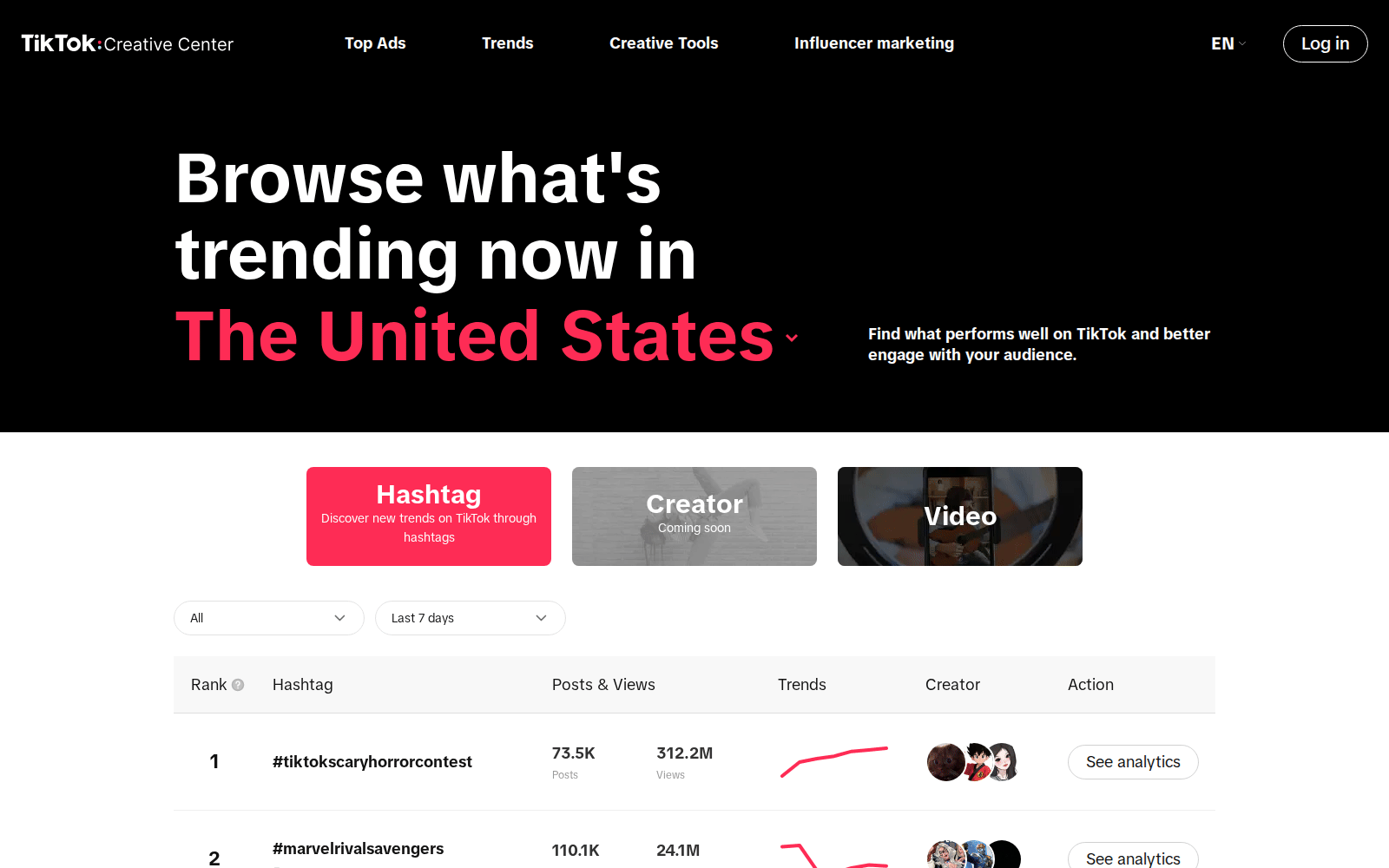
Top Ads in TikTok's Creative Center shows "high-performing auction ads on TikTok." You filter by region, industry, objective, period, language and ad format (TikTok, October 2026).
Each ad card shows likes, a CTR percentile and a budget tier, and you can sort by reach or CTR. Logging in unlocks all Top Ads. The set is limited to ads "authorized by advertisers," so it is not every top ad.
This is the place for TikTok ads, which buzzabout does not search. For the organic side of TikTok, see our TikTok engagement rate benchmarks.
- Pricing
- Free; log in to see all Top Ads (TikTok, October 2026)
- Best for
- Free TikTok ad examples by region, industry and objective
- Trial
- Not needed
Pros
- Free, from TikTok itself
- CTR percentile and budget tier on each ad
- Filters by region, industry, objective and format
Cons
- Shows only ads that advertisers authorized
- Login needed to see all Top Ads
- TikTok only
Swipe files with competitor tracking: Swipekit, Atria#
If your team saves ads every day, a swipe file earns its price. The question is which one. Tracking caps differ, so compare like with like: the cheapest plan in each tool that tracks at least 10 competitor brands automatically.
Foreplay's comparison table puts Workflow at 15 brands. Atria's Core is $159 a month on its current offer. Swipekit's $39 Basic plan tracks 5 brands.
buzzabout is not on this chart. It does not monitor competitors' ads automatically; its listening agents watch organic posts. If tracking is the job, pick from this chart.
4. Swipekit: a swipe file and brand tracker for less#
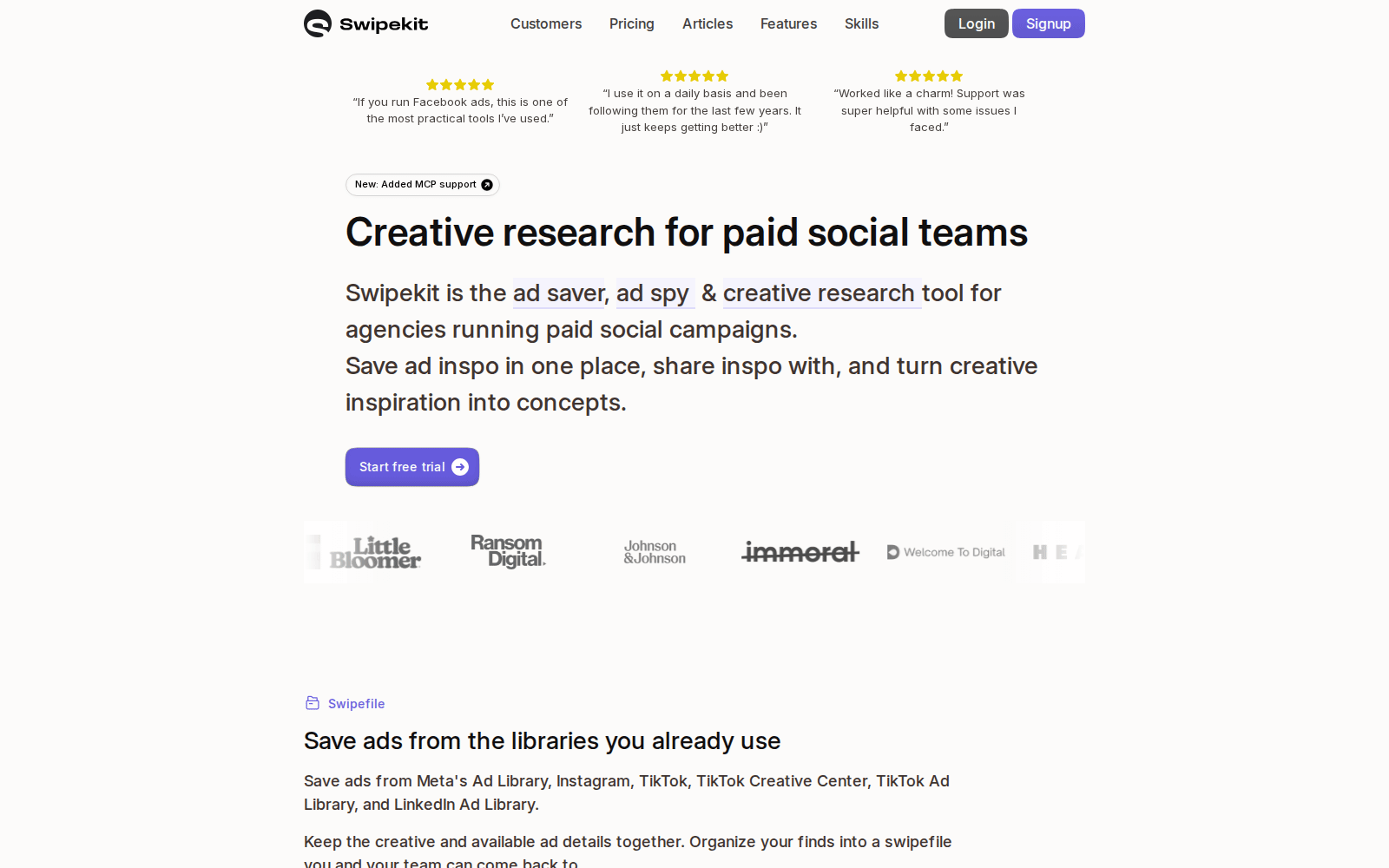
Swipekit saves ads from Meta's Ad Library, Instagram, TikTok, TikTok Creative Center, TikTok Ad Library and LinkedIn Ad Library into shared boards (vendor site, October 2026).
Its Brand Tracker checks a brand's Facebook Ad Library page regularly and shows new ads. Basic is $39 a month, or $26 a month billed annually, with 5 seats and 5 tracked brands. API and MCP access are included (vendor site, October 2026).
The trade-off is its own library. Swipekit lists a 1.5M-ad library, against Foreplay's 200M+ (vendor sites, October 2026). If you save from the platform libraries anyway, that matters less.
- Pricing
- Basic $39/mo ($26/mo billed annually) · Plus $69 ($46) · Agency $99 ($66) (vendor site, October 2026)
- Best for
- Agencies that want a shared swipe file and Meta brand tracking for less
- Trial
- 14 days free, no credit card
Pros
- 5 seats and 5 tracked brands on the $39 plan
- Saves from Meta, TikTok and LinkedIn libraries
- 14-day free trial, no card
Cons
- Built-in library of 1.5M ads, against Foreplay's 200M+
- Brand Tracker watches Meta ads only
- No ad-account analytics on its plan list
5. Atria: a swipe file, ad-account analytics and AI production in one plan#
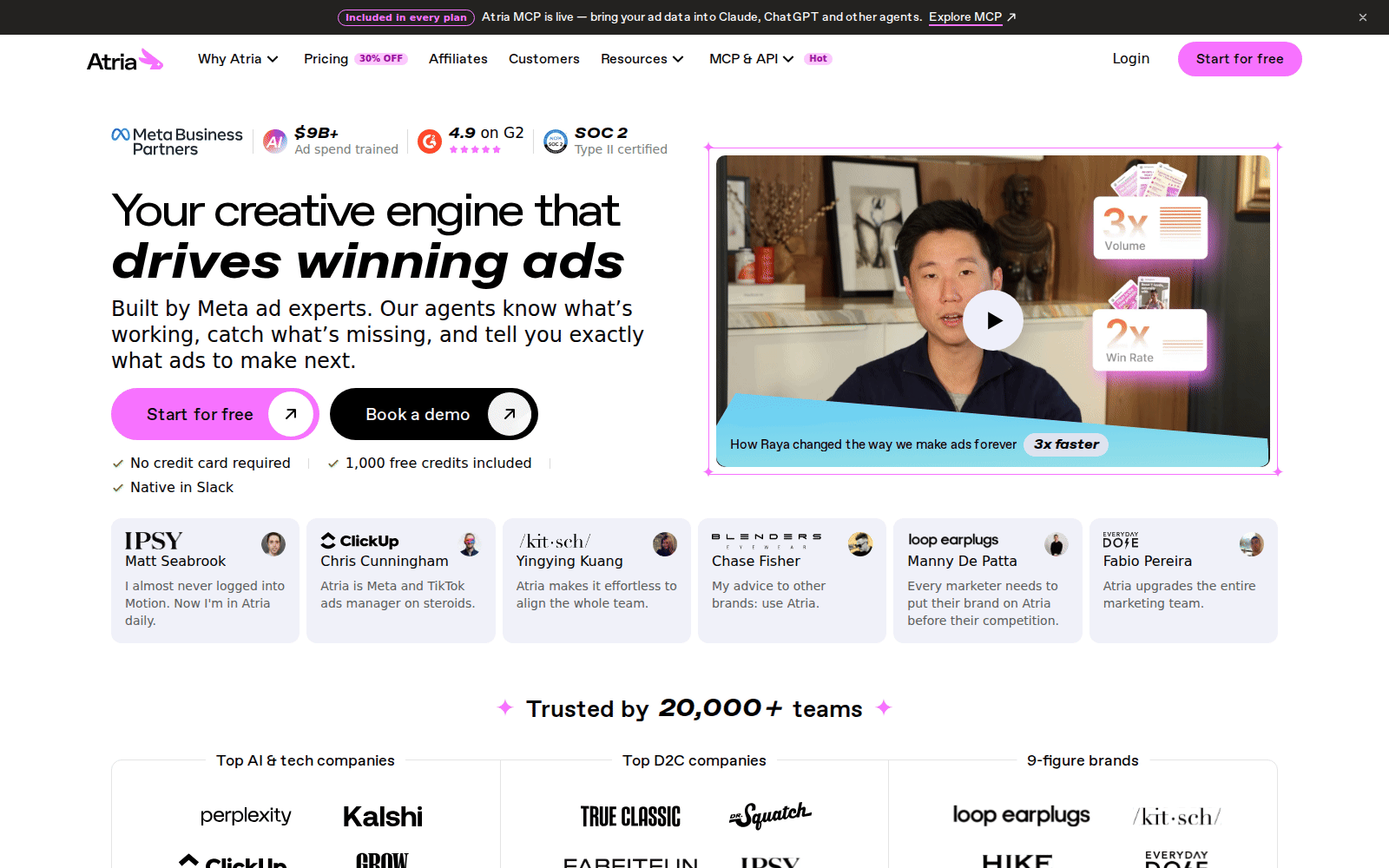
Atria combines an ad library, brand following, ad-account analytics and AI generation of concepts, scripts, copy and images. Its AI teammate, Raya, is pitched as "trained on $9B+ in real ad spend" (vendor site, October 2026).
Its pricing page also lists "Ad concepts/angles from customer review mining" as a feature. Reviews come from people who already bought. The objections that stop a purchase often sit in conversations among people who have not.
Core lists at $179 a month: 5 seats, 50 followed brands, 5 ad accounts and 4,000 AI credits. A "Black Friday Cyber Monday" offer cuts it to $159, or $129 a month billed annually. You can start free with 1,000 credits and no card (vendor site, October 2026).
- Pricing
- Core $179/mo list ($159 on its Black Friday Cyber Monday offer; $129/mo billed annually) · Plus $489 list · Business $1,369 list (vendor site, October 2026)
- Best for
- Teams that want a swipe file, ad-account analytics and AI production in one subscription
- Trial
- Free start with 1,000 credits, no credit card
Pros
- Free start with 1,000 credits, no card
- Ad-account analytics and ad library in one tool
- MCP server and REST API on every plan
Cons
- Core lists at $179/mo, about three times Foreplay Basic
- Current prices are a Black Friday Cyber Monday offer
- AI work is metered in credits on every plan
Analytics on your own ad account: Motion#
Buyers compare Motion with Foreplay, as in that r/FacebookAds thread, but the two do different jobs. Foreplay starts from other brands' ads. Motion starts from yours.
6. Motion: creative analytics for the ads you already run#
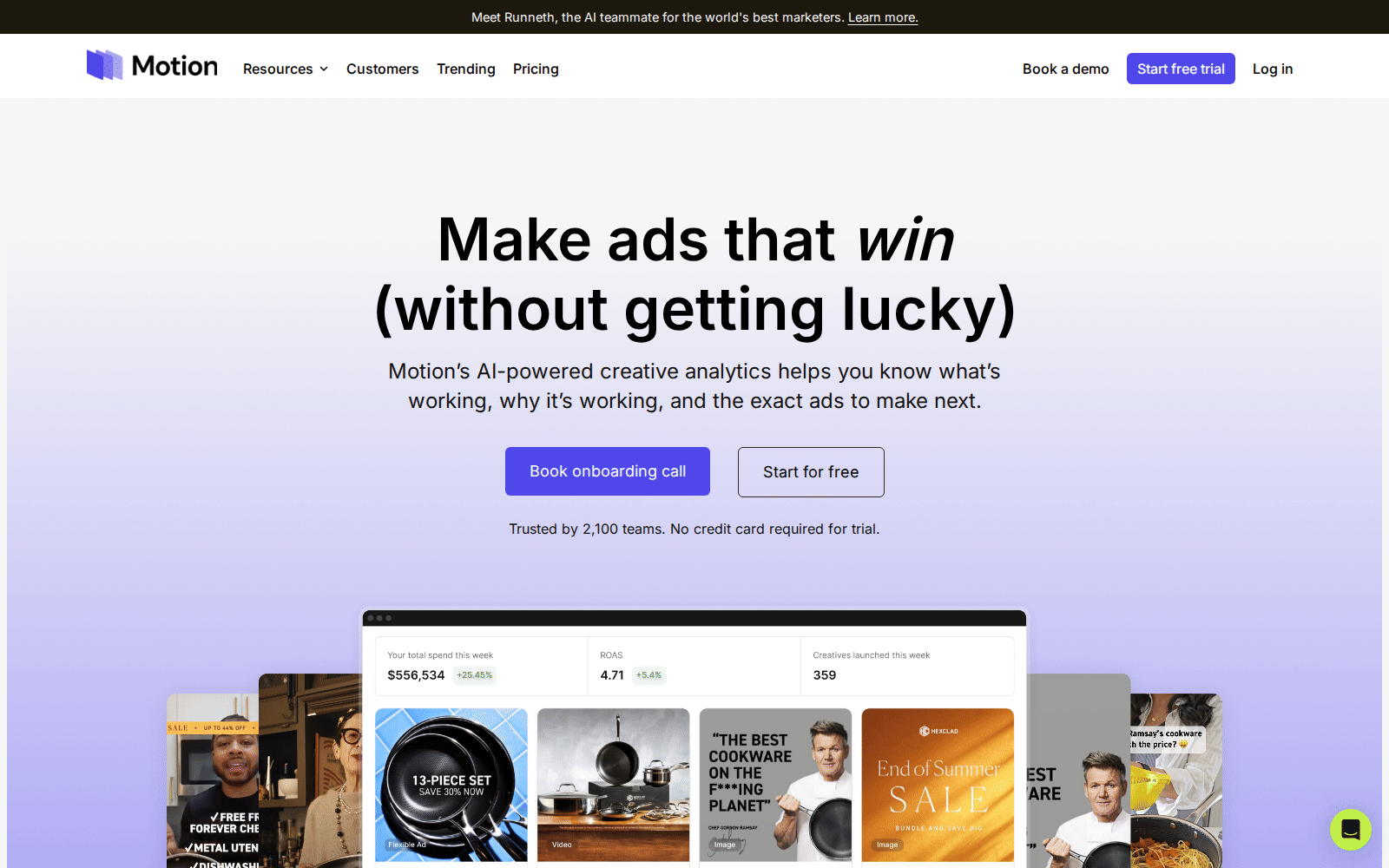
Motion builds visual reports for your Meta, TikTok, YouTube and LinkedIn ads. It AI-tags each creative by asset type, visual format, hook and creative angle, then suggests what to make next (vendor site, October 2026).
Motion says its AI tags "help achieve Andromeda-ready creative diversification" (vendor site, October 2026). That fits Meta's guidance above, on ads you have already run.
Starter is $999 a month for up to $50k in monthly ad spend, with unlimited seats and ad accounts. Pro (above $50k) and Growth (above $125k) are quoted. The trial needs no card (vendor site, October 2026).
- Pricing
- Starter $999/mo (up to $50k monthly ad spend) · Pro and Growth by quote (vendor site, October 2026)
- Best for
- Brands that want performance analytics on their own ad accounts
- Trial
- Free trial, no credit card required
Pros
- Reports for Meta, TikTok, YouTube and LinkedIn ad accounts
- Unlimited seats and ad accounts on Starter
- AI tags hooks, formats and angles automatically
Cons
- Starter is $999/mo, capped at $50k monthly ad spend
- Measures ads you ran; new concepts come from elsewhere
- Pricing above $50k monthly spend is by quote
Ad spy tools for dropshipping and affiliates: AdSpy, BigSpy#
These two come from a different tradition: search engines over large ad databases. Their own pages pitch them at affiliates, dropshippers and e-commerce, game and app advertisers.
7. AdSpy: Facebook and Instagram ad search for affiliates#
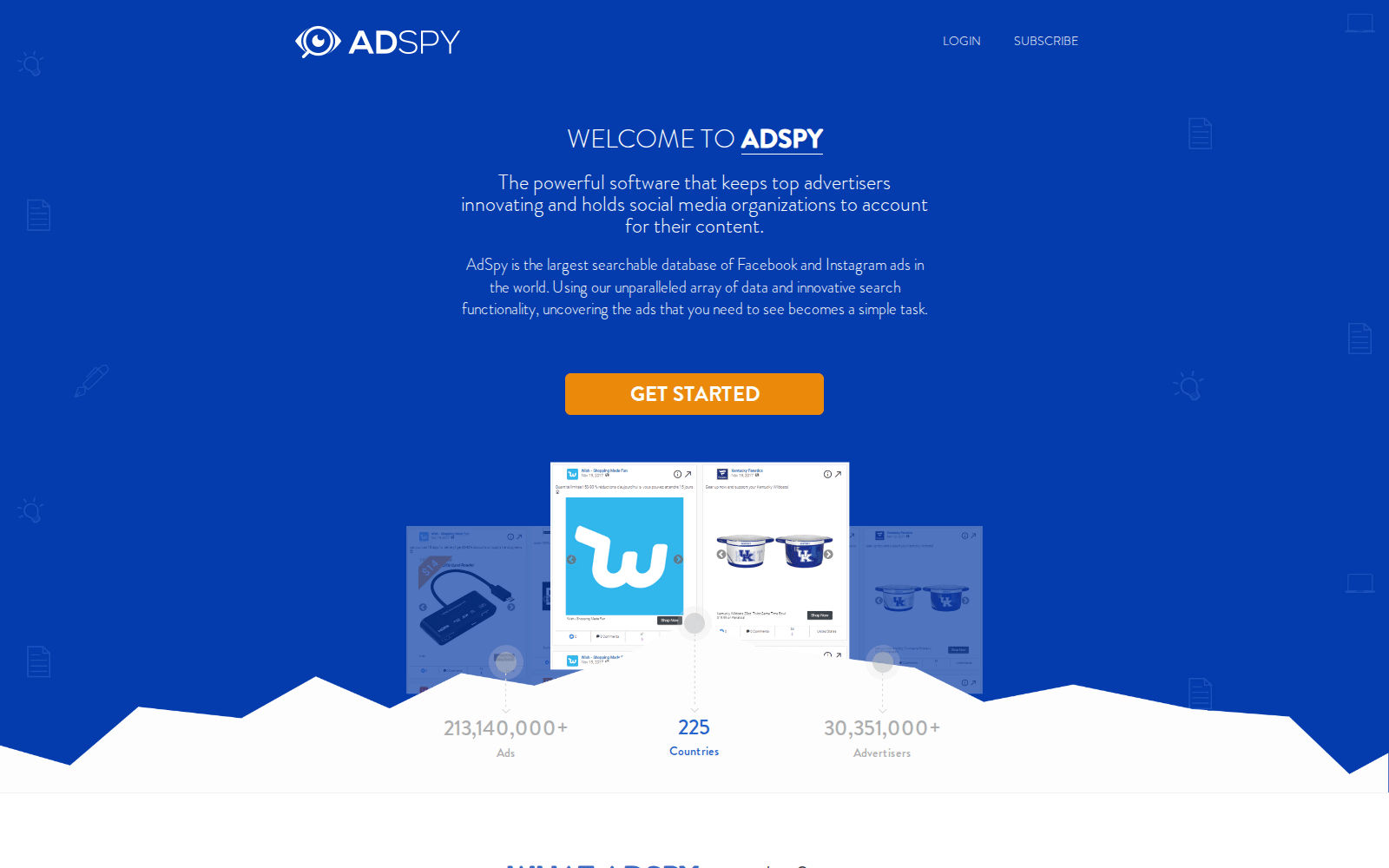
AdSpy calls itself "the largest searchable database of Facebook and Instagram ads in the world": 213.1 million+ ads across 225 countries and 88 languages (vendor site, October 2026).
You can search ad text, advertiser, URL and the comments under ads. Affiliates can filter by network, affiliate ID, offer ID and landing-page technology. Its site says: "As affiliates ourselves, we've built the tool that we want to use."
Pricing is one plan: $149 a month for "virtually unlimited usage," described as "an introductory offer" (vendor site, October 2026). No trial is listed.
- Pricing
- $149/mo, one plan, labeled "an introductory offer" (vendor site, October 2026)
- Best for
- Affiliates and dropshippers hunting offers and products
- Trial
- None listed
Pros
- Search inside ad comments as well as ad text
- Affiliate network, offer ID and landing-page filters
- One plan with "virtually unlimited usage"
Cons
- Facebook and Instagram only
- $149 is an introductory offer; no trial listed
- Search only; no boards or briefs on its feature list
8. BigSpy: ad spy across up to 11 platforms, with a free plan#
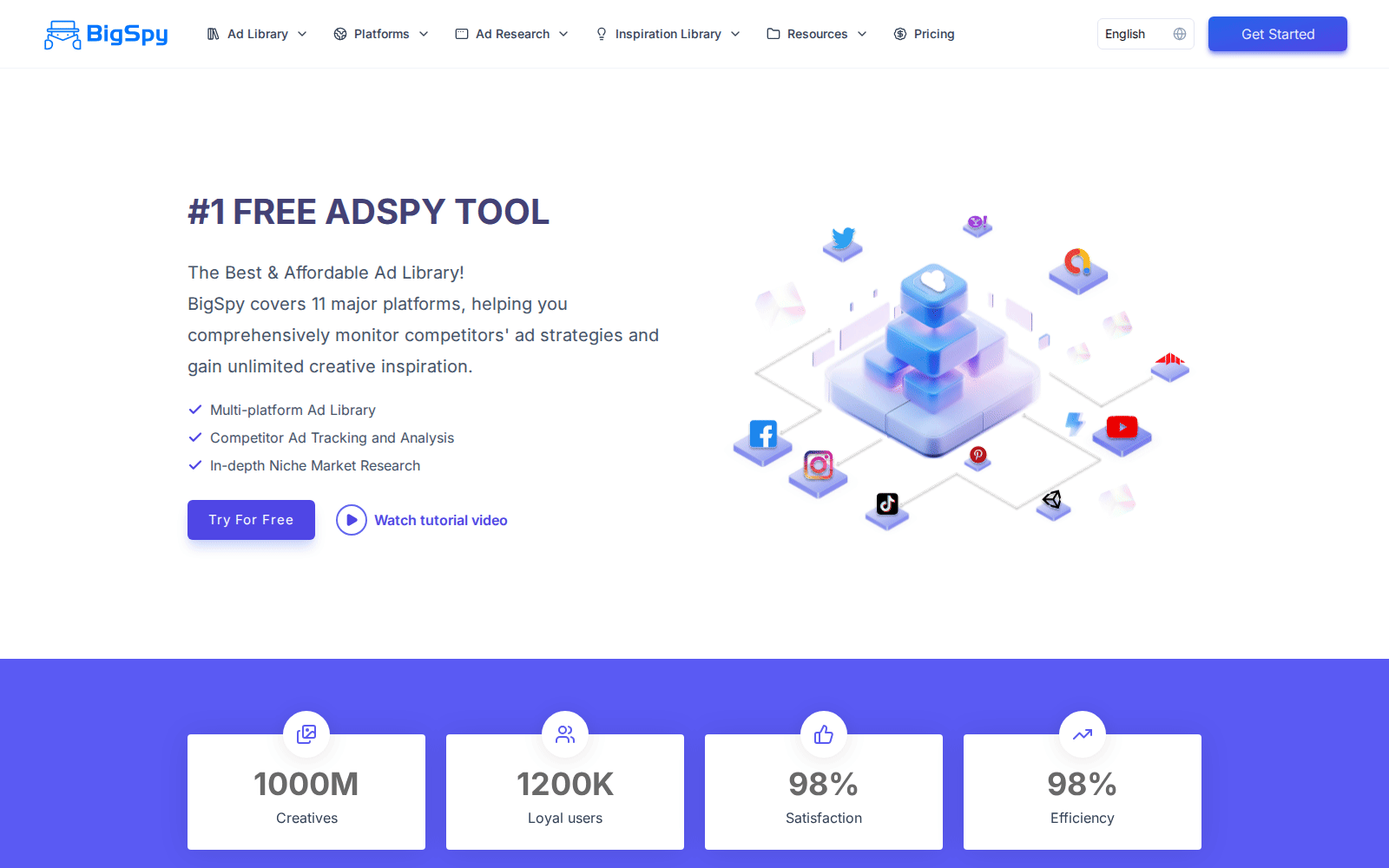
BigSpy says it covers 11 major platforms. The free plan covers Facebook ads, with 10 searches a day. Starter, at $69 a month or $588 a year, adds Instagram (vendor site, October 2026).
Growth, at $159 a month or $1,428 a year, adds Google Ads, YouTube, X, TikTok and Pangle. Only Ultimate, at $499 a month, covers all 11, including Pinterest, Yahoo and Unity (vendor site, October 2026).
Industry filters cover e-commerce, games and tools. Every plan has one seat except Scale, at $399 for five.
- Pricing
- Free · Starter $69/mo ($588/yr) · Growth $159 ($1,428/yr) · Scale $399 ($3,588/yr) · Ultimate $499 ($4,788/yr) (vendor site, October 2026)
- Best for
- Dropshippers and app advertisers hunting products and ads across networks
- Trial
- Free plan, 10 searches a day
Pros
- Free plan for Facebook ads, 10 searches a day
- Up to 11 ad platforms, including TikTok and YouTube
- Industry filters for e-commerce, games and tools
Cons
- TikTok, YouTube and Google ads start on Growth ($159/mo)
- One seat on every plan except Scale
- Daily caps on downloads and visual search
What about just asking ChatGPT for ad concepts?#
ChatGPT will write fifty hooks in a minute. Asked cold, it draws on its training data: the most common ways to sell your category. That is convergence again, only faster.
As our AI UGC ads analysis puts it, production has been solved; the angle has not. A model cannot know what your buyers said last month unless you give it their words.
Ground it instead. buzzabout's MCP connectors, on every plan, let Claude or ChatGPT read your collected, labeled conversations, so the hooks rest on real quotes. Ad searches stay in the buzzabout app.
From audience research to five distinct ad concepts#
Here is the full loop: research first, market check second. It works with any research tool, though the steps assume one that collects comments.
- Ask about the buyer's problem, not your product.
- Collect posts and comments where buyers discuss it. Reddit, TikTok, YouTube and more.
- Pull pains, objections and outcomes, each with real quotes in buyers' words.
- Group them by reason to buy. Each group can carry one concept.
- Draft five concepts with the prompt below.
- Check each concept in the Meta Ad Library. Who already says it?
- Keep the open angles and reframe the crowded ones. Launch them as distinct ads.
Paste your grouped quotes into any assistant:
You are a performance creative strategist. Below are real quotes from
my buyers, grouped by pain, objection and desired outcome.

1. Write five ad concepts. Each must rest on a different reason to buy.
2. For each concept give: the buyer insight, the persona, a hook in the
   buyers' own words, the objection it answers, and a format idea.
3. Quote the line from my data that each concept rests on.
4. Flag any two concepts that share a reason to buy, and replace one.
5. Do not invent quotes. If the data cannot support five, say so.

Product: <product>
Quotes:
<paste your grouped quotes>
Step 6 is where competitors' ads earn their place: as a check, not a source. In buzzabout, save the matching ads into a collection and ask the assistant which hooks they already use.
How to choose#
Your ads need concepts from what buyers feel, fear and say
→ buzzabout
Pains, objections and exact words from seven platforms.
You want to check what competitors run on Meta, where you research
→ buzzabout
Meta Ad Library search by keyword or advertiser, in the same app.
You want your AI assistant writing concepts from real conversations
→ buzzabout
MCP connectors for Claude and ChatGPT on every plan.
You need a quick, free look at one brand's live Meta ads
→ Meta Ad Library
Free, no account needed; no spend shown for most ads.
You need TikTok ad examples
→ TikTok Creative Center
Free; buzzabout does not search TikTok ads.
You save, tag and share ads all day across a team
→ Foreplay or Swipekit
Swipekit from $39/mo with a 14-day trial, no card.
You need automated tracking of competitors' new ads
→ Swipekit, Foreplay Workflow or Atria
buzzabout does not monitor competitor ads automatically.
You need analytics on your own ad account
→ Motion or Atria
buzzabout does not connect to ad accounts.
You run dropshipping or affiliate offers
→ AdSpy or BigSpy
Ad databases with affiliate and e-commerce filters.
Frequently asked questions#
What is the best Foreplay alternative? For finding what an ad should say, buzzabout: it researches buyers' pains, objections and words across seven platforms, then searches the Meta Ad Library in the same app. For a cheaper swipe file, Swipekit starts at $39/mo. For analytics on your own ads, Motion and Atria do that job.
Is there a free alternative to Foreplay? Yes. The Meta Ad Library is free with no account, TikTok Creative Center is free, and BigSpy has a free plan. buzzabout offers "a $1 one-day trial with 1,000 credits, followed by 50% off your first paid month," and Swipekit has a 14-day trial with no card.
How much does Foreplay cost? Basic is $59 a month ($49 billed yearly), Workflow $175 ($149), and Agency $459 ($389). Enterprise is custom, and extra users cost $20 each. Competitor tracking (Spyder) and analytics (Lens) start on Workflow (vendor site, October 2026).
Does Foreplay have a free trial? Yes, for 7 days, but it needs a credit card. Its FAQ says you are "automatically subscribed" when the trial ends, with a 14-day money-back guarantee after the first charge. Annual plans are not refunded on cancellation (vendor site, October 2026).
What is the difference between Foreplay and Motion? Foreplay starts from other brands' ads: a swipe file, a 200M+ ad library and competitor tracking, with analytics of your own ads from Workflow. Motion starts from your ad account: creative reports from $999 a month (vendor sites, October 2026).
Is Foreplay worth it? It is if your team saves, tags and shares ads every day, or needs Spyder's competitor history. If you mostly browse, the Meta Ad Library and TikTok Creative Center are free. Neither tells you what your buyers want to hear.
Can buzzabout replace Foreplay? For finding concepts and checking them against Meta ads, yes. For saving ads with an extension, TikTok ads, automated competitor tracking or analytics on your own ad account, no. If your team lives in a swipe file, keep one and add buzzabout for the concepts.
Start the next concept with your buyers#
Pick one product and ask one question about its buyers: what stops them? Read the objections in their words, write five concepts, and check each against the Meta Ad Library in the same app.
buzzabout's pricing page has the trial on monthly plans: "a $1 one-day trial with 1,000 credits, followed by 50% off your first paid month." Your competitors' ads will still be in the library when you need the check.