
On this page
The best Audiense alternative in 2026 is buzzabout, because Audiense tells you who an audience is, while buzzabout shows what people say, what to say back, and who is saying it. You ask a question, it reads the conversation on seven platforms, then profiles the people who commented (Pro and up).
buzzabout is a social media research platform, and the difference is the model. Audience tools map who follows whom. Listening tools count keywords and alert on spikes. Research extracts what a conversation means: topics, pain points, objections, and the audience's own words.
Audiense is also a different company than it was two years ago. Below: what changed, what each alternative knows about an audience, and which job each one fits, with every price sourced.
Audiense tells you who, not what they say#
Audiense built its name on one idea: map who follows whom, cluster those people into communities, and describe each one. Its Discover product still builds audiences from "Followers, connections, communities" plus interests and affinities (vendor site, October 2026).
That answers a real question: who is this audience? The same page lists "Conversation data" too, but as an attribute of the segment, not the starting point. So two questions stay hard: what are these people saying now, and what should we say back?
G2's May 2026 roundup of brand intelligence software names the limit: "Insights are built primarily from publicly available X data" (G2). One G2 reviewer spells out the cost:
"...it is not always a true representation of an overall audience."
G2 reviewer on Audiense Discover, on its X-based data
The same reviewer adds that it is often "better than nothing". Fair, and still a ceiling.
A follow is the weak signal#
A follow is cheap. People follow for a giveaway, one viral post, or a job they left years ago, and the graph keeps them. It records attention once paid, not what anyone thinks today.
A comment costs effort. Someone stopped scrolling and wrote, in their own words, what they want, what annoys them, and what they would pay for. Copy, positioning, and product calls are built from exactly that.
Keyword listening misses it from the other side: it counts how often a word appears, not what the people using it want. So audience research is moving to "what people actually say". Four tests separate the models:
- Where does the audience come from? Follower graph, survey panel, keyword count, or conversation.
- Can you read their words? Quotes and objections, or only labels about them.
- How fresh is it? Last quarter's survey wave, or this week's comments.
- Can you price it today? Public plans, or a trial request and a call.
What Audiense became in 2026#
The Audiense most buyers remember was a social audience tool. In March 2025, Fort Worth's Buxton, a consumer analytics company backed by PSG, bought it (Dallas Innovates). Buxton had bought Elevar, an ecommerce conversion tracking platform, the year before.
On July 8, 2026, the three companies relaunched under one name, Audiense (PR Newswire). The product map now reads like an enterprise consumer-intelligence suite:
- Discover: audience research, the "new home" for Insights, Affinio, Soprism, Connect, and Demand
- Action: AI chat and "AI personas grounded in real consumer data"
- In-Person: Buxton's location intelligence for stores and site planning
- Online: Elevar's conversion tracking for ecommerce sites
- Data Services: APIs, MCPs, and appending data to your own consumer records
Those descriptions come from the relaunch release and the vendor site (October 2026). Discover also packages "targeting packs" for media planning and campaign activation, and a customer quote on the Discover page describes segments "uploaded to Meta ads manager".
No price on the page#
That is a broader company, and a heavier purchase. Discover and Action show no public price. The old pricing URL returns a 404, and the main call to action reads "Request a free trial" (vendor site, October 2026).
Only Audiense Online, the former Elevar, lists plans, starting with a free tier. For the audience products, the last public number we found is Social Intelligence at $696/mo billed annually, or $1,499 billed monthly, in a PricingSaaS capture dated July 5, 2026. That was three days before the rebrand.
The relaunch does point at the X problem. The release says the legacy tools will now orient around Meta, TikTok, LinkedIn, YouTube, X, and other platforms. Test coverage on your own audience before relying on it.
One more fork in the road. If what you need from Audiense is segments to load into an ad platform, the suite is built for that, and buzzabout does not do it at all. If you need to understand an audience well enough to write to it, read on.
Audiense alternatives compared#
Monthly is the list price on monthly billing. Annual is the yearly list price, or Vendr's median contract where no price is published. buzzabout appears at Pro, its first plan with audience research. Vendor pages were checked in October 2026.
| Tool | Monthly | Annual | Starts from | Psychographics | Ad-targeting exports |
|---|---|---|---|---|---|
| buzzabout | $178 (Pro) | $1,780 (Pro) | A question, 7 platforms | OCEAN + interests, AI-estimated | None |
| Audiense | Not published | Not published | Follower graphs | Values, personality traits | Targeting packs |
| SparkToro | $150 (Business) | $450 (Personal) | Follows, sites, searches | Topics of interest | Media lists only |
| GWI | Not published | ~$78.5k (Vendr median) | Survey panel | Interests, attitudes | Audience activation |
| Resonate | Not published | ~$101k (Vendr median) | Modeled US profiles | Values, motivations | Activation (Ignite) |
| Pulsar | Not published | Not published | Conversations | Affinities, interests | Not advertised |
| Brandwatch | Not published | ~$50k (Vendr median) | Queries, 2008 archive | None advertised | Not advertised |
| Talkwalker | Not published | ~$13.3k (Vendr median) | Keyword topics | Interests | Not advertised |
The last column is an activation job, not research. buzzabout has no ad exports at all; the How to choose table routes that job.
Where a yearly number exists at all, the spread runs from a few hundred dollars to six figures:
Read the two kinds of bar differently. A Vendr median is what buyers paid under negotiated contracts, whatever seats and modules they bought. A list price is what one team pays to start.
Pulsar is missing because it publishes no price and Vendr has no benchmark for it. Audiense's bar is the July 2026 capture of $696/mo on annual billing, and it may not survive the relaunch.
#1 · The research pick
1. buzzabout: hear the audience first, then profile who spoke#
buzzabout is a social media research platform. Audiense starts from the follow graph. buzzabout starts from a question and the conversation it pulls, then works out who is talking.
- Ask in plain language. "Why do people cancel meal kits?"
- Read the conversation. Seven platforms, up to 100 comments per post, video included.
- Profile who commented. AI-estimated demographics and OCEAN personality, on Pro and up.
What separates it#
- Their words, labeled. Emotion, intent, hook, and narrative tagged on every mention.
- People who spoke. Profiles of commenters, not of everyone who once followed.
- Video understood. Speech transcribed, on-screen text read, logos and objects detected.
- Agents that process. Always-on listening agents push extracted pains and topics to Slack.
- Into your AI tools. MCP connectors on every plan; API from Business.
The sources are Reddit, YouTube, X, LinkedIn, TikTok, Instagram, and Facebook. Commenters on all but YouTube can be profiled: age, gender, country, city when declared, language, occupation, industry, interests, brand affinities, and OCEAN scores.
Every field is AI-estimated from real public profiles, so treat it as an estimate, not a census. Then a research assistant mines patterns, samples quotes, splits cohorts, and builds shareable live charts, so you can see which group raises which objection.
Who, plus what to say#
Audiense hands you a segment to target. buzzabout hands you what the people in a conversation object to, in their own words, and an estimate of who they are. Our step-by-step guide to audience research with AI shows the method end to end.
- Pricing
- Starter $98/mo ($980/yr) · Pro $178 ($1,780/yr) · Business $450 ($4,500/yr), per buzzabout pricing
- Audience research
- Pro and up; 3 credits per profile, 1 credit per mention
- Best for
- Marketers and agencies who need to know what an audience says, and how to answer it
- Trial
- a $1 one-day trial with 1,000 credits, followed by 50% off your first paid month (monthly plans)
On Pro, 5,000 monthly credits buy a 1,000-mention research (1,000 credits) plus up to about 1,300 commenter profiles. A full year of Pro costs $1,780, about a fifth of Audiense's last public Social Intelligence price on annual billing.
What it does not do matters here. buzzabout exports no targeting packs, enriches no CRM lists, maps no store locations, and tracks no ecommerce conversions. If that is the job, the rest of Audiense's suite, or Resonate, covers it.
Pros
- Starts from a question, not a follower graph or Boolean string
- Seven platforms, with video and audio transcribed
- Commenter profiles with OCEAN scores, AI-estimated, on Pro and up
- MCP on every plan; API on Business and up
Cons
- No targeting-pack or ad-audience exports
- No CRM enrichment, location intelligence, or ecommerce tracking
- No news, print, or broadcast monitoring
- YouTube commenters cannot be profiled
The profile tools: follows, surveys, and modeled data#
These three answer Audiense's question, who is this audience, from three different sources: what people follow and visit, what they tell a survey, and what a model predicts. None of them reads the conversation itself.
2. SparkToro: where your audience spends time, from $38/mo#
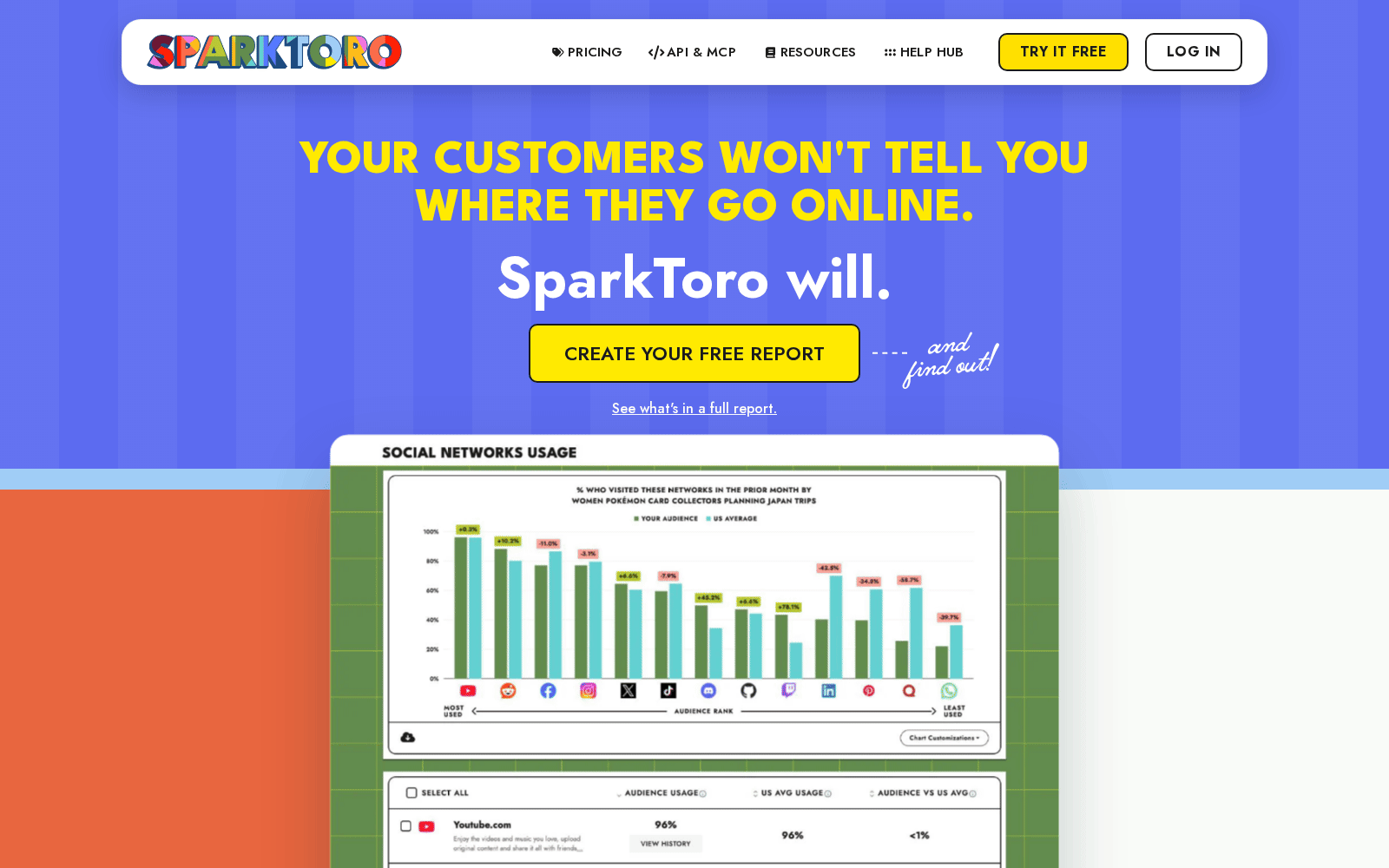
SparkToro is the closest self-serve cousin of the old Audiense. Describe an audience in a sentence and it returns where those people go: social networks, websites, podcasts, YouTube channels, subreddits, and accounts they engage with more than average (vendor site, October 2026).
Pricing is public. A free plan gives 3 report previews a month, Personal is $38/mo on annual billing for 4 reports, and Business is $150/mo for 25 reports and 10 users (vendor site, October 2026). Paid plans include MCP access; Business adds Persona Builder.
The ceiling is the question it answers. It tells you where to show up, not what the audience says once you are there, and it advertises no personality data.
- Pricing
- Free (3 previews/mo) · Personal $38/mo, annual only ($450/yr) · Business $150/mo, or $112/mo billed annually (vendor site, October 2026)
- Best for
- Media and PR planning: which sites, podcasts, and accounts reach an audience
Pros
- Public, self-serve pricing with a free plan
- Media lists ready for sponsorship, PR, and SEO outreach
- MCP access on every paid plan
Cons
- Shows where people go, not what they say
- No personality scores advertised
- Personal plan: 4 reports a month, one user
3. GWI: what people tell a survey, across 50+ markets#
GWI answers "who is this audience" with survey data. It gathers responses from "almost a million internet users" a year through its own online surveys in 50+ markets, released in 4 waves a year (vendor site, October 2026).
That makes it strong where Audiense is weak: representative numbers on interests, attitudes, and buying habits you can compare across countries. Agent Spark, its AI analyst, answers in plain language, and an MCP connector brings the data into ChatGPT and Claude (vendor site, October 2026).
The limit is the format. A survey hears answers to the questions GWI wrote, on its schedule. Pricing is per seat, by quote; Vendr's median buyer pays $78,500 a year.
- Pricing
- Per seat, by quote; Vendr median $78,500/yr (source)
- Best for
- Global brands that need survey-grade audience numbers across markets
Pros
- Representative survey data across 50+ markets
- Agent Spark AI analyst and an MCP connector
- 15+ years of trended data (vendor site, October 2026)
Cons
- Answers to fixed questions, released in waves
- No public pricing; Vendr median $78,500/yr
- Cannot quote what your audience said this week
4. Resonate: modeled US consumer data for targeting#
Resonate covers the job Audiense's targeting packs do: build a segment, then push it to ad channels. It claims 250M+ US adult profiles, 15,000+ predictive attributes, and a daily data refresh (vendor site, October 2026).
Its psychographics cover "the values, motivations, and beliefs that drive consumer decisions". Ignite, its self-serve platform, builds audiences and activates them across channels, and Resonate also sells enrichment for your own customer records (vendor site, October 2026).
Read its homepage line closely: "You can't collect this kind of signal. You have to predict it." Every profile is a prediction, and the data covers US consumers. Vendr's median buyer pays $101,000 a year.
- Pricing
- By quote; Vendr median $101,000/yr (source)
- Best for
- US ad targeting, audience activation, and CRM enrichment
Pros
- Built for activation: segments flow to ad channels
- CRM enrichment with 15,000+ modeled attributes
- Psychographics: values, motivations, and beliefs
Cons
- US consumers only
- Modeled predictions; no quotes from real conversations
- Six-figure median contract, per Vendr
The listening suites with audience segments#
These three start from keyword queries over social conversation, then segment the people in it. All three sell enterprise contracts, the same shape we compare in Sprinklr alternatives.
Look at what those contracts price. Dashboards that took analysts weeks to build are now one AI prompt, and deep archives depreciate because markets move and research needs fresh data. Much of the price pays for that past.
5. Pulsar: conversation plus community segmentation, by demo#
Pulsar TRAC combines social listening and media monitoring with audience segmentation, so you can see how different communities talk about the same topic (vendor site, October 2026). Like buzzabout, it starts from the conversation; unlike buzzabout, it sells by demo.
Coverage is wide: social, search, and news data from 195 countries, plus print, TV, radio, and podcasts. "Social panels" follow segments like doctors or basketball fans over time. Pulsar Group also owns the PR brands Vuelio and Isentia (vendor site, October 2026).
Access is the catch. There is no public price; every path leads to a demo, for either the SaaS subscription with training or consultancy research. Segments are built on affinity and interest, and no personality model is advertised.
- Pricing
- Not published; subscription or consultancy, by demo (vendor site, October 2026)
- Best for
- Teams that want social listening plus print, TV, and radio monitoring in one contract
Pros
- Segments the people inside a conversation, by community
- Social, news, print, broadcast, and podcasts in one platform
- Research and consultancy available on top
Cons
- No public pricing; demo required
- No personality model advertised
- Built for analysts running a standing program
6. Brandwatch: a 2008 archive, with audiences as dashboards#
Brandwatch Consumer Research, now sold alongside Cision, draws on "over 100 million online sources" and 1.4 trillion posts back to 2008, with the Iris AI assistant on top (vendor site, October 2026).
Its plans page pitches the ability to "Segment audiences and conversations in fully customizable dashboards" (vendor site, October 2026). It is an archive-first product, priced like one: Vendr's median buyer pays $50,000 a year. We map the field around it in Brandwatch alternatives.
- Pricing
- Custom annual contracts; Vendr median $50,000/yr (source)
- Best for
- Enterprise teams buying listening together with Cision's comms suite
Pros
- 1.4 trillion posts archived back to 2008
- Iris AI assistant and image analysis
Cons
- No public pricing; Vendr median $50,000/yr
- No personality model advertised
- Archive depth prices the past; research needs fresh data
7. Talkwalker: listening with audience segments, now Lumen#
Talkwalker now trades as Lumen by Talkwalker, which the vendor says reflects bringing "Hootsuite and Talkwalker closer together" (vendor site, October 2026). Its audience insights product targets people by sentiment, interests, and behaviors.
The pricing page lists Core, Analyze, and Business tiers, all by custom quote with unlimited users, drawing on 150 million data sources and 30+ social platforms in 187 languages (vendor site, October 2026).
Vendr's median buyer pays $13,298 a year. The full field is in Talkwalker alternatives.
- Pricing
- Custom quotes (Core, Analyze, Business); Vendr median $13,298/yr (source)
- Best for
- Brand and comms teams wanting listening, monitoring, and benchmarking in one contract
Pros
- Unlimited users on every plan
- 150 million sources in 187 languages
- Also reads support tickets and call transcripts
Cons
- Custom quotes only; demo first
- Audience segments sit inside a monitoring product
- No personality model advertised
What about AI personas, or just asking ChatGPT?#
Audiense and Resonate now sell a synthetic stand-in for your audience. Audiense Action offers "AI personas grounded in real consumer data", and Resonate markets Digital Twins as a "synthetic panel" (vendor sites, October 2026).
A persona answers in the voice a model predicts. It is only as current as the data under it, and it cannot quote a customer, because it never heard one. ChatGPT on its own is the same, minus the data.
Grounding fixes both. buzzabout's MCP connector, on every plan, lets Claude or ChatGPT query the conversations you collected, plus commenter profiles on Pro and up. Each answer points back to what people actually said.
How to choose#
Choose by the job. Exporting segments for ad targeting is one job; knowing what to say to that segment is another, and few tools do both.
You need to know what your audience says, and what to say back
→ buzzabout
It reads the conversation, then profiles the people who commented.
You need to know who is talking about a topic: age, occupation, personality
→ buzzabout
AI-estimated profiles of commenters on every source but YouTube, on Pro and up.
You want Claude or ChatGPT answering from real conversations
→ buzzabout
MCP connectors on every plan, from $98/mo.
You need segments exported into ad platforms
→ Stay on Audiense, or price Resonate
Targeting packs and activation are their job; buzzabout has no ad exports.
You need US consumer records appended to your CRM
→ Resonate
Modeled US profiles with 15,000+ attributes; Vendr median $101k/yr.
You need store and site-planning data
→ Audiense In-Person
Buxton's location intelligence now lives there.
You plan media: which sites, podcasts, and accounts reach them
→ SparkToro
Public pricing, from $38/mo on annual billing.
You need survey numbers comparable across 50+ markets
→ GWI
Panel data in four waves a year; Vendr median $78.5k/yr.
You need print, TV, and radio monitoring next to social
→ Pulsar
Broadcast and podcast sources; demo-gated, by contract.
Your comms team already buys from Cision
→ Brandwatch
Sold alongside Cision; Vendr median $50k/yr.
Frequently asked questions#
What is the best Audiense alternative? For knowing what an audience says, how to answer it, and who is saying it, buzzabout. It reads conversations on seven platforms and profiles the commenters with AI-estimated demographics and OCEAN personality, on Pro and up. For ad-targeting exports, the closer swap is Resonate.
How much does Audiense cost in 2026? Discover and Action carry no public price; the old pricing page returns a 404 and trials are by request (vendor site, October 2026). The last public figure, in a PricingSaaS capture from July 5, 2026, was Social Intelligence at $696/mo billed annually, or $1,499 billed monthly.
Is Audiense only X (Twitter) data? Not by design: Discover lists Instagram, TikTok, LinkedIn, YouTube, and more (vendor site, October 2026). But G2's 2026 roundup says insights are "built primarily from publicly available X data" (G2), and the July 2026 relaunch promises a wider orientation.
Did Buxton buy Audiense? Yes. Fort Worth's Buxton, backed by PSG, acquired Audiense in March 2025 (Dallas Innovates). On July 8, 2026, Buxton, Elevar, and Audiense relaunched under the single Audiense name (PR Newswire).
Audiense vs SparkToro: which should I use? They answer different questions. SparkToro shows where an audience spends time online, from $38/mo on annual billing (vendor site, October 2026). Audiense segments audiences for targeting, by quote. Neither starts from what the audience is saying; buzzabout does.
Which Audiense alternatives include personality data? buzzabout scores the people who commented on OCEAN (Big Five) personality, AI-estimated from public profiles, on Pro and up (pricing). Resonate sells modeled psychographics, "values, motivations, and beliefs", for US consumers (vendor site, October 2026).
Can buzzabout replace Audiense for ad targeting? No. buzzabout has no targeting-pack or ad-audience exports, no CRM-list enrichment, no location intelligence, and no ecommerce tracking. It replaces the research half: what the audience says, and who said it.
Hear the audience, then profile it#
A follower map tells you who an audience was when they clicked follow. The conversation tells you what they think this week, in words you can reuse, and the commenter profiles tell you how to phrase the answer.
Ask one real question about your market and see what comes back: pains, objections, buyer language, and the people behind them. buzzabout's pricing page starts with a $1 one-day trial with 1,000 credits, followed by 50% off your first paid month, on monthly plans.