
On this page
buzzabout vs Brandwatch comes down to how you pay for a question. Brandwatch is an enterprise consumer intelligence suite, sold through a demo and priced by the saved queries in your contract, or by monthly mentions on bigger tiers. buzzabout is an AI agent for social media research: you ask in plain language, self-serve, from $98 a month.
Pick buzzabout if you are a marketer, an agency or an insights team that needs to know what your audience says this week, on TikTok, Instagram, YouTube, Reddit, X, LinkedIn and Facebook, without an annual contract or a trained query writer. It reads posts, comments and video transcripts, and it works inside Claude and ChatGPT.
buzzabout vs Brandwatch at a glance#
| buzzabout | Brandwatch | |
|---|---|---|
| How you start | Try it for free and ask today | "Schedule your free demo"; no prices on its site |
| Price | Starting at $49 (first month of Starter), then $98 a month | Vendr median $50,000 a year |
| Contract | Monthly; cancel any time | Annual contracts are standard |
| How you ask | A question in plain language | A saved query, built in its query editor |
| What the plan counts | No query quota; 1 credit per post kept | Saved queries: 5 on the entry tier for £10,800 a year |
| Exporting posts | CSV and PDF from Pro, $178 a month | Mention exports: "No" on the entry tier |
| Images and video | Speech transcribed; frames read for objects, logos and on-screen text | Image Insights £14,440 a year extra; each logo you add £4,608 a year |
| A written report | A report, persona or brief in minutes, shared with one link | Analyst reports £7,500 to £22,500 each |
Brandwatch figures come from its plans page (vendor site, November 2026), Vendr's purchase data and Brandwatch's own UK G-Cloud 14 pricing document. buzzabout figures come from our pricing and about pages.
How much does Brandwatch cost in 2026?#
Brandwatch publishes no prices on its website. Its plans page offers "standard to enterprise plans" for each product and ends in a form titled "Schedule your free demo" (vendor site, November 2026).
Two public sources fill the gap. Vendr, which records real software purchases, puts the median Brandwatch contract at $50,000 a year, with a range of $19,542 to $81,200 across 40 purchases. It adds that "annual contracts are standard" (Vendr).
The most detailed source is Brandwatch's own price list for the UK government's G-Cloud 14 framework. Consumer Intelligence is sold by saved queries or by monthly mentions. On the query model, pricing is "based on the number of concurrent search queries saved at any given time," and the entry Pro tier is sold only that way: 5 saved queries for £10,800 a year, about £900 a month (G-Cloud pricing document).
A year of buzzabout Starter costs $980 on annual billing (pricing). That is about one week of the median Brandwatch contract.
What does a saved query cost your research?#
A saved query is a question you keep tracking, and the entry tier holds five. Brandwatch search is unlimited, but each tracked question needs a slot, and the next five slots add £5,400 a year on the Pro tier (G-Cloud pricing document).
So teams ration the questions they track. The question that came up in Tuesday's meeting waits for a free slot or the renewal, and research narrows to whatever the contract already covers.
Writing each query is a skill of its own. Brandwatch's guide to queries says: "Unless you're searching for a single word, your query won't work without operators" (vendor site, November 2026). The guide means Boolean operators: AND, OR, NOT, NEAR, quotation marks and wildcards. Templates and an AI assistant help, but the result is still a query string someone has to check and save.
buzzabout has no saved-query quota. You type the question the way you would ask a colleague: "What makes people doubt LED face masks before they buy?" The agent finds the posts, reads them with their comments and transcripts, and answers with the posts behind each finding. Each post you keep costs one credit, and Starter comes with 2,000 credits a month.
Does a bigger archive make better research?#
Brandwatch's headline asset is its archive: "1.7 trillion historical conversations back to 2010," with 501 million more added every day (vendor site, November 2026).
In the AI era that archive is aging capital. Markets move, so last year's conversation answers last year's question. Dashboards that once took a trained analyst to build are now one prompt. And on the entry Pro tier a saved query reaches back only one year; older history is an add-on sold on Premium and Enterprise, from £2,880 a year (G-Cloud pricing document).
Brandwatch's own price list sells written analysis as a service. A short analyst report costs £7,500, a detailed one £15,000 and an in-depth one £22,500, each one-off, plus expert hours at £190 to £200 an hour (G-Cloud pricing document).
buzzabout collects the posts a question needs when you ask it, and the agent writes the report itself. Listening agents then check your niche every day and send what is new to Slack.
What does a plain-language question return?#
Here is one answer in public. Our report on AI market research reads posts on LinkedIn, X and Reddit and sorts them by what people talk about (AI market research report, October 1, 2026).
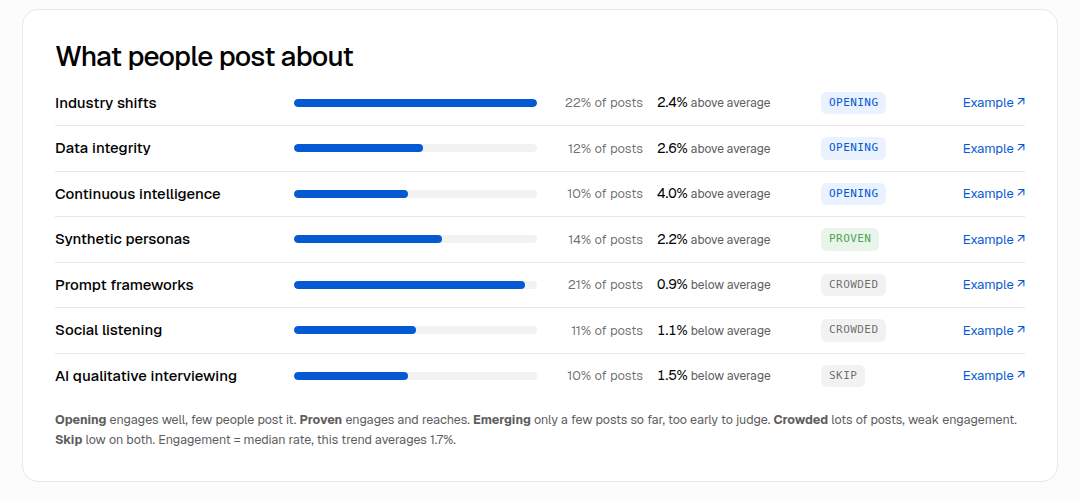
Two lines carry the answer. Posts about social listening make up 11% of the conversation and engage at 1.1%, below the 1.7% average, so the report labels the angle Crowded. Posts about continuous intelligence make up 10% and engage at 4.0%, labeled Opening: it engages well and few people post it.
The report then turns those angles into three post ideas, each linked to an example post. A saved query returns the mentions that match it. A question returns what to say next, with the proof attached.
How do you switch from Brandwatch to buzzabout?#
You can run both for a month and decide before the renewal. In order:
- Find the renewal date. Check the notice period in your contract first; annual terms are standard (Vendr).
- Export what you must keep. The G-Cloud price list includes dashboard exports on every tier, but marks mention exports "No" on the entry tier. Save the dashboards and reports you need before access ends.
- List your saved queries. Next to each, write the question it was built to answer.
- Ask those questions in buzzabout. Pick the platforms where your audience talks, then compare the answer with your last dashboard.
- Turn standing queries into listening agents. They check your niche every day and send digests to Slack or a webhook. Starter includes 1 agent, Pro 3, Business unlimited.
- Move the reporting. Share reports and briefs by link, export CSV or PDF from Pro, use the REST API on Business, or ask from Claude and ChatGPT through the buzzabout MCP server on any plan.
To turn your Boolean strings into questions, paste each one into any assistant:
Below is a saved Boolean query from our social listening tool.

1. Say in one sentence what question this query was built to answer.
2. Rewrite it as one plain-language research question about our audience.
3. Suggest two follow-up questions we never asked because each would
   have needed another saved query.

Query:
<paste the Boolean string>
Frequently asked questions#
Is buzzabout a Brandwatch alternative?#
Yes, for research: what your audience says, why it says it, and what to say next. buzzabout answers plain-language questions across seven platforms, self-serve, starting at $49 for the first month. Our Brandwatch alternatives guide covers the rest of the field, and the Meltwater alternatives guide covers the PR suites.
Do I need to write Boolean queries in buzzabout?#
No. You ask in plain language, and the agent decides what to collect. Nobody on your team needs training in operators or brackets.
Can buzzabout replace our Brandwatch dashboards?#
For research, yes. Each question comes back as a report, a persona or a brief, with charts, shared with one link. For a standing view, set a listening agent: it checks your niche every day and sends a digest to Slack or a webhook.
What does buzzabout cost compared with Brandwatch?#
Starter is $98 a month ($49 for the first month), Pro $178 and Business $450, or $980, $1,780 and $4,500 a year. Prices cover the whole plan, not each seat (pricing). Brandwatch's median contract is $50,000 a year (Vendr).
Will our security and procurement teams accept buzzabout?#
The Enterprise plan adds SSO and SCIM, a security review pack with the SOC 2 report, DPA and sub-processor list, custom contract terms and invoicing in your currency (pricing). The self-serve plans need only a card.
Can we run buzzabout next to Brandwatch until the renewal?#
Yes. Monthly plans can be cancelled any time and keep access to the end of the period, so you can compare answers side by side before the renewal date.
Does buzzabout work inside Claude and ChatGPT?#
Yes. The buzzabout MCP server works in Claude, ChatGPT and Cursor on every plan (MCP). Custom connectors depend on your ChatGPT plan.
Ask the question you have been saving a slot for#
Pick one question your team never asked because it would have needed another saved query. Ask it today across TikTok, Reddit and the other five platforms, and read the answer with the posts behind it.
Try for free. Every head-to-head we have written is on our comparisons page.