
On this page
buzzabout vs Motion is a choice between looking back and looking forward. Motion, the creative analytics tool for Meta, TikTok, YouTube and LinkedIn ad accounts, shows which of your ads already won. buzzabout reads what your customers post and comment on seven platforms and tells you what to say in the next ad, with the posts that prove it.
Pick buzzabout if you need angles you have not tried yet: a new product, a new market, a creative test that keeps recycling the same hooks, or a budget that cannot carry a $999 monthly analytics plan. This page is about Motion the ad analytics platform, not the calendar app of the same name.
buzzabout vs Motion at a glance#
| buzzabout | Motion | |
|---|---|---|
| Built around | What your buyers post and comment on 7 platforms | The creatives and metrics in your ad accounts |
| Where the next idea comes from | What customers ask, doubt and want, counted and linked to posts | Mainly your ad history: "recent wins, and historical learnings" |
| Works before your first ad | Yes: ask about any product, audience or market | Its own agent site: "Most of Runneth's value comes from your ad data" |
| Entry price | Starting at $49, then $98 a month | $999 a month |
| Tied to ad spend | No; one price per plan | Starter covers up to $50k monthly ad spend; above that, by quote |
Motion figures are from its homepage, its pricing page and the site of Runneth, its AI agent (vendor sites, November 2026). buzzabout figures are from our pricing page.
What does Motion do?#
Motion is a Toronto company that "sells analytics and research tools for creative strategists" and raised a $30 million Series B led by Inovia Capital in September 2024 (BetaKit).
It connects to your ad accounts and builds visual reports for your Meta, TikTok, YouTube and LinkedIn ads. Its AI tags each creative by asset type, visual format, hook and creative angle, then suggests what to make next. Motion says its AI builds your strategy around "your brand's unique context, recent wins, and historical learnings" (vendor site, November 2026).
Its core job is grading the ads you have run, for 2,100 teams by its own count. Its Runneth agent, included from Starter, can also follow the creators, keywords and brands you point it to. But by Runneth's own account, "Most of Runneth's value comes from your ad data" (vendor site, November 2026).
How much does Motion cost in 2026?#
Motion's Starter plan is $999 a month for brands spending up to $50k a month on ads, with unlimited seats and ad accounts. Pro, for spend above $50k, and Growth, for larger budgets, are quoted on a call (vendor site, November 2026).
buzzabout is priced per plan, with no link to your ad spend: Starter $98 a month ($49 for the first month), Pro $178, Business $450 (pricing).
Even buzzabout's Business plan, with 20,000 credits, the REST API and unlimited listening agents, costs less than half of Motion's entry plan.
Why can't an ad account tell you what to say next?#
An ad account holds only the ideas your team already had. Motion's analytics can rank them well. No ad report can rank the objection nobody wrote an ad about.
Meta now asks advertisers for exactly those missing ideas. With its AI ad tools, Meta says "the focus has shifted from niche targeting to creative diversification as the best lever" (Meta for Business, April 22, 2025). Its method for finding them: "build personas that outline different customer needs and blockers to purchase" (Meta for Business, November 19, 2024).
Customer needs and blockers to purchase are not in your ad account. They are in what buyers say to each other: TikTok comments, Reddit threads, YouTube reviews. That is what buzzabout reads.
What does buzzabout show that an ad account cannot?#
Take a typical direct-to-consumer product. Our report on LED face masks reads TikTok posts about them and sorts them by angle (LED face mask report, September 30, 2026):
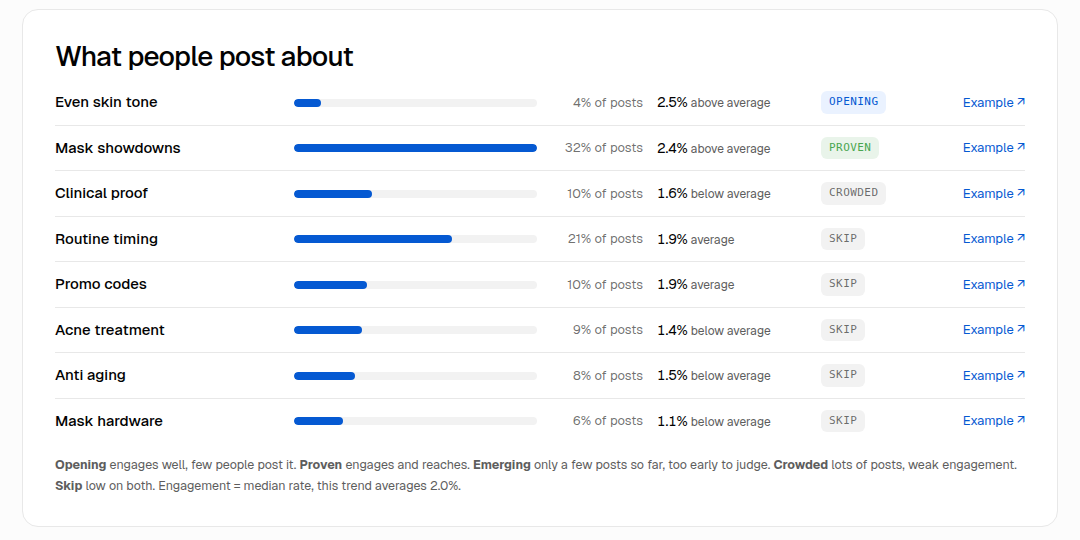
Three lines tell a brand what to say next:
- Mask showdowns fill 32% of posts and engage at 2.4%, above the 2.0% average. Proven: it engages and reaches.
- Clinical proof fills 10% of posts and engages at 1.6%. Crowded: lots of posts, weak engagement.
- Even skin tone fills only 4% of posts and engages at 2.5%. Opening: it engages well, and few people post it.
The same report groups the questions people ask about them:
The top group is doubt: "Are LED masks a scam?" The next is choice: "Which LED Mask Should You Buy??" Then value: "But at £300 is it actually worth it?"
A brand whose account holds only clinical-proof ads would learn which clinical-proof ad won. The open angle and the top question come from the buyers. The report then turns them into three ready ideas, among them a "Pigmentation Friendly LED Routine" built on the even skin tone angle.
Can you use buzzabout and Motion together?#
Yes, and the order matters: research first, measurement second. buzzabout finds the angle and writes the brief. Your team or your creators make the ads. Your analytics tool then reports which version won.
If you already pay $999 a month to grade your ads, buzzabout Starter adds the step before the test for $98. The buzzabout MCP server puts the same research inside Claude and ChatGPT.
Frequently asked questions#
Is this Motion the same as the Motion calendar app?#
No. This page compares Motion, the creative analytics platform from Motion Creative Cloud Inc. An unrelated AI calendar and task app is also called Motion.
Does buzzabout connect to my ad account?#
No, and it does not need to. buzzabout reads public posts and comments, so it works for a product you have never advertised and a market you have not entered yet.
Can buzzabout replace Motion?#
It replaces the guess at the start of every test: what the next ad should say. It does not report on your spend or ROAS. If you need that report, keep it, and put buzzabout in front of it.
How fast does buzzabout answer?#
In minutes. The median run to fully analyzed posts takes 3.5 minutes (TikTok MCP). Listening agents then check your niche every day and flag what is new in Slack.
What does buzzabout cost?#
Starting at $49 for the first month of Starter, then $98 a month. Pro is $178 and Business $450. Prices cover the whole plan, not each seat (pricing).
What other tools do creative teams compare?#
Our Foreplay alternatives guide covers swipe files, ad libraries and ad-account analytics, and buzzabout vs Atria covers the AI creative suites. Every comparison is on our comparisons page.
Write the next brief from your buyers#
Pick the product you are briefing next. Ask what its buyers doubt, compare and want, and read the answer with the posts behind it. Then let your analytics tool grade what you ship.