
On this page
buzzabout vs Atria comes down to where your next ad angle starts. Atria, the AI creative platform for Meta and TikTok ads, starts from ads: yours, your competitors' and its ad library, plus reviews from people who already bought. buzzabout starts from what people post and ask on seven platforms, before and after they buy, and turns it into the brief.
Pick buzzabout if your buyers do their deciding on Reddit, YouTube or LinkedIn as well as TikTok, if you need objections from people who have not bought from you yet, or if you want the research without paying for an ad-production suite.
buzzabout vs Atria at a glance#
| buzzabout | Atria | |
|---|---|---|
| Where the customer's voice comes from | Public posts and comments, before and after people buy | Reviews and testimonials ("review mining") |
| Platforms it reads | TikTok, Instagram, YouTube, Reddit, X, LinkedIn, Facebook | "Currently focuses on Meta and TikTok" |
| What an angle rests on | Questions, doubts and wants, counted and linked to the posts | Your ads, competitors' ads, review mining and its ad-spend data |
| First paid plan, billed monthly | Starting at $49, then $98 a month | Core $219 list; $159 on its current offer |
Atria figures are from its homepage, FAQ and pricing page (vendor site, November 2026). buzzabout figures are from our pricing page.
What does Atria do?#
Atria calls itself "an AI-powered creative management platform" covering the ad workflow "from competitor research and ideation to creating ads, launching campaigns, and analyzing performance" (vendor site, November 2026).
Its AI teammate, Raya, is pitched as "trained on $12B+ in real ad spend." Raya analyzes "your brand. Your ads. Your data," then layers on "competitor intel, customer insights, and $12B in market intel." Atria connects to your Meta and TikTok ad accounts and runs an ad library it puts at 100M+ Meta and TikTok ads (vendor site, November 2026).
On customer research, its pricing page lists "Analyze customer testimonials using AI" and "Ad concepts/angles from customer review mining." On channels, its FAQ is direct: "Atria currently focuses on Meta and TikTok," with Google, YouTube, Pinterest and LinkedIn "on the roadmap" (vendor site, November 2026).
How much does Atria cost in 2026?#
Atria's Core plan lists at $219 a month for 5 seats. A "Black Friday Cyber Monday" offer on its pricing page cuts it to $159 a month, or $129 a month billed annually. Plus lists at $549 a month and Business at $1,549 (vendor site, November 2026).
buzzabout Starter is $98 a month, $49 for the first month, or $980 a year. Pro is $178 and Business $450. Prices cover the whole plan, not each seat (pricing).
Why do reviews miss the objection that stops the sale?#
A review comes from someone who bought. The person who almost bought and walked away left no review. Their objection is still out there: in the comments under a creator's video, in a Reddit thread, in a YouTube review of a rival product.
Meta asks advertisers for exactly that input. Its guidance on creative diversification says to "build personas that outline different customer needs and blockers to purchase" (Meta for Business, November 19, 2024). With its AI ad tools, Meta says "the focus has shifted from niche targeting to creative diversification as the best lever" (Meta for Business, April 22, 2025).
A blocker to purchase is, by definition, what stopped someone buying. You find it where people talk before they buy. Mining your reviews finds what convinced the people who already did.
What do people ask about a product in public?#
Here is what that looks like for one product. Our report on hair growth serums reads TikTok posts about them and groups the questions people ask (hair growth serum report, September 30, 2026):
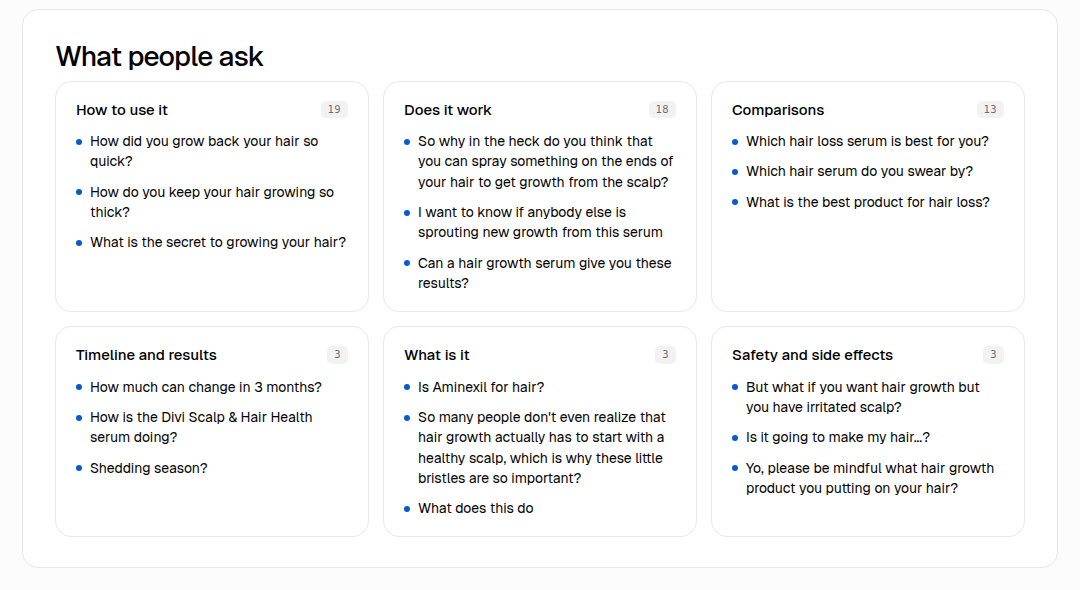
These are the questions in the conversation. "Can a hair growth serum give you these results?" "Which hair loss serum is best for you?" "But what if you want hair growth but you have irritated scalp?" Each one is an objection an ad can answer.
The report also says where the open space is. Its summary: "condition-specific answers and texture clarity are under-served." Both angles carry the Opening label, meaning they engage well and few people post them. Brand comparisons fill only 6% of posts but engage at 2.8%, against a 1.8% average for the trend.
Then it hands over three ideas. One, "Will It Dry Clear on Edges", is a mini vlog testing three serums on edges with a close-up residue check, built on the texture angle. That is what to say next, from the public conversation rather than your own reviews.
Can you use buzzabout with Atria?#
Yes. If your team builds and launches Meta ads in Atria, put buzzabout upstream. It supplies the angle and the brief, with the posts that prove the angle, and your production tool takes it from there. The buzzabout MCP server brings the same research into Claude and ChatGPT.
Frequently asked questions#
Does Atria read Reddit, YouTube or LinkedIn?#
Its FAQ says Atria "currently focuses on Meta and TikTok," with Google, YouTube, Pinterest and LinkedIn on the roadmap (vendor site, November 2026). buzzabout reads TikTok, Instagram, YouTube, Reddit, X, LinkedIn and Facebook today.
Does buzzabout make the ads?#
It writes the brief: one document built from what it found, with the posts behind it, for your content team, creators or AI video tools. Production stays with the people and tools you already use.
Does buzzabout connect to my Meta ad account?#
No, and it does not need to. It reads public posts and comments, so it works for a product you have never advertised and an audience you have not reached yet.
What does buzzabout cost?#
Starting at $49 for the first month of Starter, then $98 a month. Pro is $178 and Business $450, or $980, $1,780 and $4,500 a year (pricing).
Can buzzabout replace Atria's customer research?#
For finding angles, yes, and with a wider net: posts and comments from people before and after they buy, on seven platforms, instead of reviews from people who bought. From Pro, buzzabout also profiles the people who commented: AI-estimated age, occupation, interests and OCEAN personality.
What else do creative teams compare?#
Our Foreplay alternatives guide covers swipe files, ad libraries and ad-account analytics. buzzabout vs Motion covers creative analytics. Every comparison is on our comparisons page.
Start your next ad with the buyers who have not bought yet#
Pick the product you are briefing next. Ask what stops people from buying it, and read their questions in their own words, with the posts behind each one.